What the Royal Commission Said About Families, and Who It Left Out
The final report was not the last word. Six recommendations touch families. Three were agreed, and they look forward. The one that could reach the families of the drug trials was only noted.
Versión en español: Lo que la Comisión Real dijo sobre las familias, y a quién dejó fuera
When the Royal Commission into Defence and Veteran Suicide delivered its final report on 9 September 2024, I read it the way many families did: as the last word. Seven volumes, 122 recommendations, and then silence.
That reading is wrong, and it took me some time to see why. The report is the end of the Commission. It is not the end of the question. Most of what it recommended is still being decided.
This page sets out what the Commission said about families, how the Government answered, and where the families of the antimalarial drug trials stand. The answer to the last part is: nowhere yet, with one opening.
What the Commission said about families
Families have their own chapter. It is in Volume 6, Chapter 27, titled "Importance of families". The Commission accepted that service life places heavy strain on families, and it recognised a link between family violence and suicide among serving and former members.
Six recommendations bear on families.
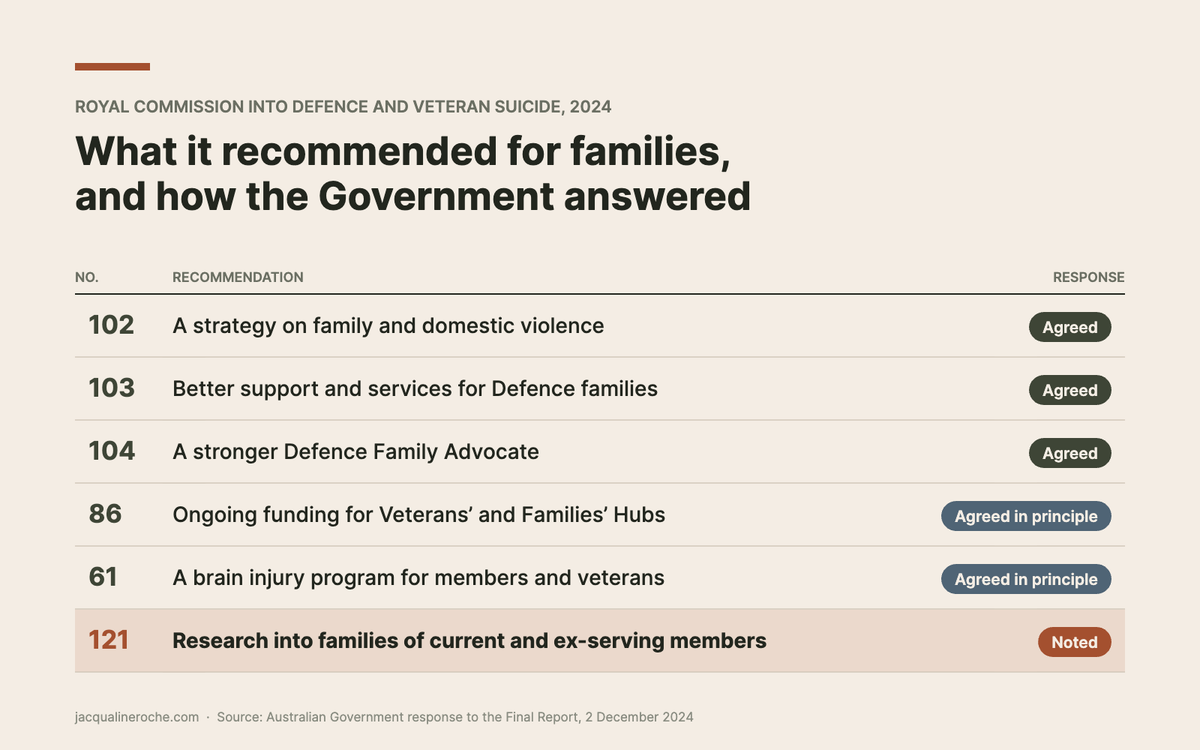
- Recommendation 102 calls for Defence to carry out its strategy on family and domestic violence, with the safety of victims, including children, as the first consideration. The Government agreed.
- Recommendation 103 calls for better support, communication and services for Defence families. Agreed.
- Recommendation 104 calls for a stronger Defence Family Advocate. Agreed.
- Recommendation 86 calls for ongoing funding for Veterans' and Families' Hubs. Agreed in principle.
- Recommendation 61 calls for a brain injury program. Agreed in principle, and sent to a taskforce.
- Recommendation 121 calls for research into the health and wellbeing of "families of current and ex-serving members". Noted.
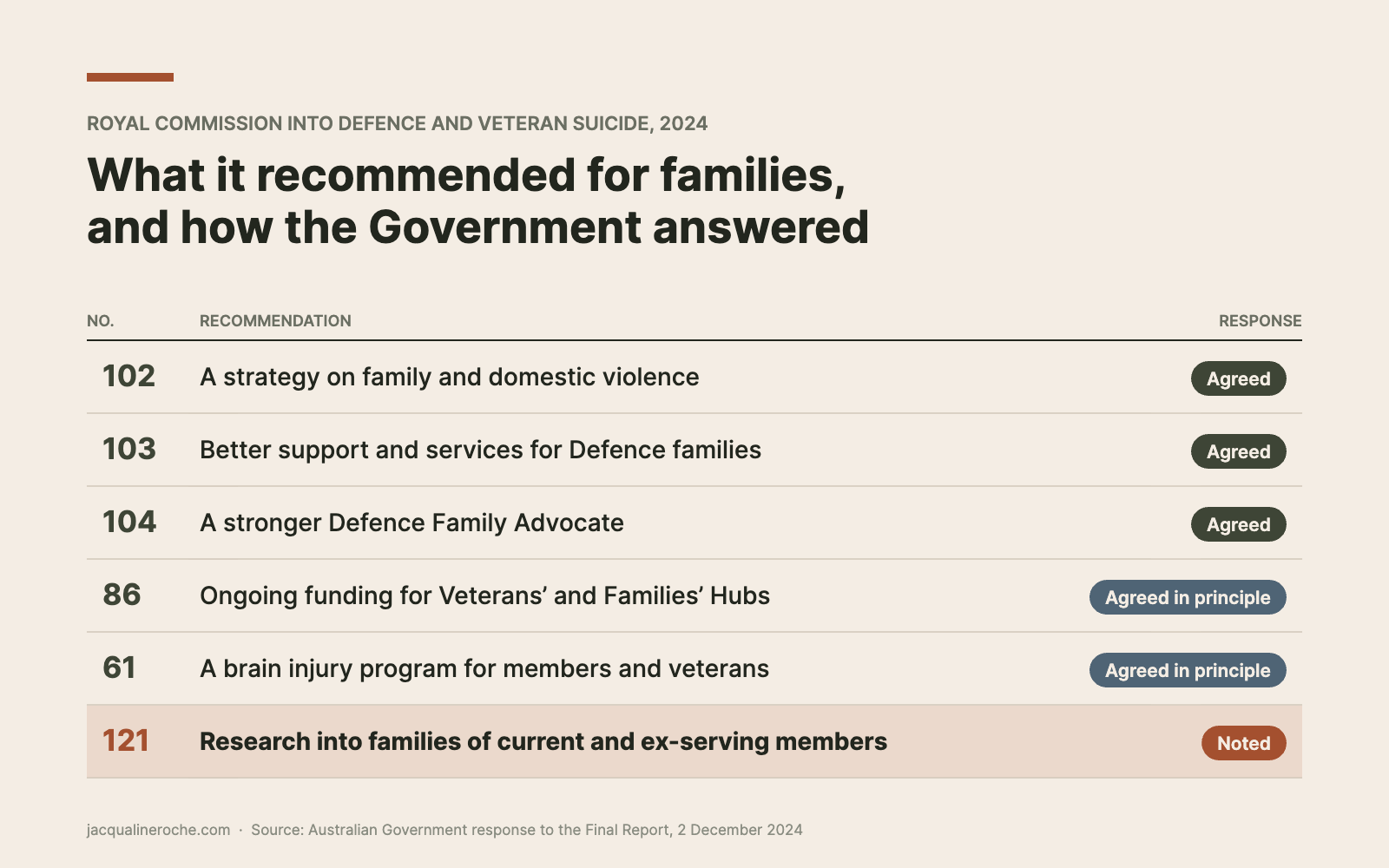
Three words: agreed, in principle, noted
The Government responded on 2 December 2024. It agreed, or agreed in principle, to 104 of the 122 recommendations. The words it chose for each one matter.
Agreed means the Government has committed to do it. Agreed in principle means it accepts the aim and has not committed to the method or the timing. Noted means it has acknowledged the recommendation and committed to nothing.
The three recommendations that were agreed outright all concern Defence families now: people married to, or living with, someone who is serving. They look forward.
Who that leaves out
I was married for seventeen years to a soldier who deployed to East Timor in 1999 and again in 2001, during the Army Malaria Institute's trials of mefloquine and tafenoquine. The marriage ended in 2017. He is a veteran. I am a former spouse.
Read against my own situation, the six recommendations fall away one by one.
- The family violence strategy governs how Defence behaves from now on. It does not reach back to what happened in a household twenty years ago.
- Support for Defence families and the Family Advocate are for the families of serving members.
- The brain injury program is the one recommendation that names the trial drugs. The Commission said it should cover members exposed to mefloquine or tafenoquine. The Department of Veterans' Affairs describes it as a program for serving and ex-serving members. Neither mentions the people who lived with them.
- Former partners are not mentioned anywhere I have found. The language is "families" and "partners and children". Whether a woman who was married to a soldier through both deployments, and is no longer married to him, counts as family is not stated.
This follows the pattern I set out in the timeline of the trials. Every inquiry since 2016 has asked what was done to the soldier. None has asked what came home with him.
The one opening
Recommendation 121 is different from the others. It is the only one that speaks of the families of ex-serving members, and the only one that calls for research instead of services.
A study of the partners and children of the men who took part in those trials would sit squarely inside it. So would the question I raised in I Was Never Asked: why the one study of East Timor families reached partners only through the soldier.
It is also the recommendation with the weakest answer. It was noted. The taskforce is to consider options.
What has happened since
- 29 September 2025. The Defence and Veterans' Service Commission began work. Its task is to monitor whether the recommendations are carried out.
- 31 March 2026. Parliament passed the law making that Commission permanent. Its functions were widened to include veterans' families.
- 1 July 2026. A new Veteran and Family Wellbeing Agency was launched.
- 9 September 2026. The Government's two-year update reported 32 recommendations implemented by the end of 2025, with about two-thirds expected by the end of 2026. It did not mention the brain injury program, the family research, or the trial drugs.
Will there be a next time?
That is the question underneath all of this. Not whether former spouses will be asked next time, but whether there will be a next time at all.
The one study built around these deployments is the Timor-Leste Family Study. Its questionnaires went out in 2011. That is fifteen years ago, and twelve years after the first deployment.
Its numbers were low to begin with. More than 7,000 current and former members were invited, and 36.8 per cent completed the questionnaire. Partners were invited only where the member supplied their details, and 1,332 replied, 36.1 per cent of those invited. Former partners were given a questionnaire, and their answers were then left out of the results. A larger research programme in 2015 included partners only where the member agreed, and left former partners out altogether. The figures and their sources are set out in I Was Never Asked.
So the figures that exist for East Timor families are old, come from about a third of the people approached, and exclude the women who had left. If nothing replaces that study, it remains the official picture of what those deployments did to families. Recommendation 121 is the only place in the Royal Commission’s report from which a new one could come, and it was noted.
What I am asking for
Four things, each of which fits inside a recommendation the Government has already received.
- That there be a new study. The existing one is fifteen years old and was built on a low response.
- That the research under Recommendation 121 include the families of trial participants, and that it reach partners directly, not through the veteran.
- That former spouses be counted as family for that research. A marriage that ended after the harm does not erase the years inside it.
- That the brain injury program, when it is designed, ask what the household needs, not only the member.
On 3 October 2026 I wrote to the Veteran Family Commissioner to ask why former spouses were not asked. The question I should have put first is the one above: will there be a next time? On 5 October 2026 I wrote again and asked it. I will publish the reply.
The report was not the last word. The last word has not been written, and families are entitled to help write it.
Related reading
- After the Marriage Ends
- The ADF Antimalarial Drug Trials: A Timeline, 1999–2024
- I Was Never Asked
- Left Behind
- What You Can Do
Sources
- Royal Commission into Defence and Veteran Suicide, Final Report, 9 September 2024, and Volume 6, Chapter 27.
- Defence and Veterans' Service Commission, Royal Commission recommendations and Government responses.
- Department of Veterans' Affairs, Brain injuries.
- Department of Veterans' Affairs, Two years on: progress continues on Royal Commission reforms, 9 September 2026.
- Minister for Defence, Independent Defence and Veterans’ Commission up and running, 29 September 2025.
- Minister for Defence, Defence and Veterans’ Service Commissioner Bill passes Parliament, 31 March 2026.