What You Can Do
Precisely how journalists, lawyers, clinicians, policymakers, and members of the public can act on what this series documents.
Versión en español: Lo que usted puede hacer
ACTION NOTE — WHAT THE RECORD SUPPORTS
PARLIAMENT · PRESS · LAW · CLINICAL PRACTICE · RESEARCH · POLICY
I was an army wife. My former husband was deployed to East Timor, where he participated in the antimalarial drug trials this series documents. I lived with the consequences for years before I had the evidence or the framework to understand what had happened — to him, to me, and to our family. This series is the result of that understanding.
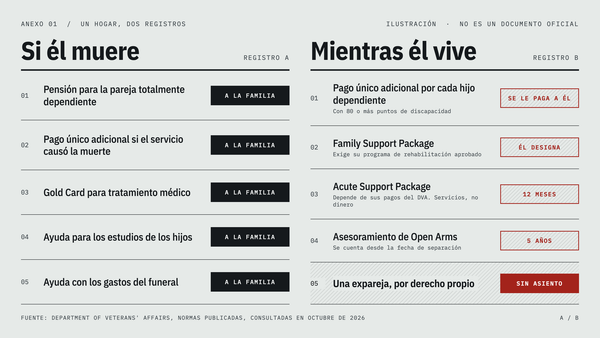
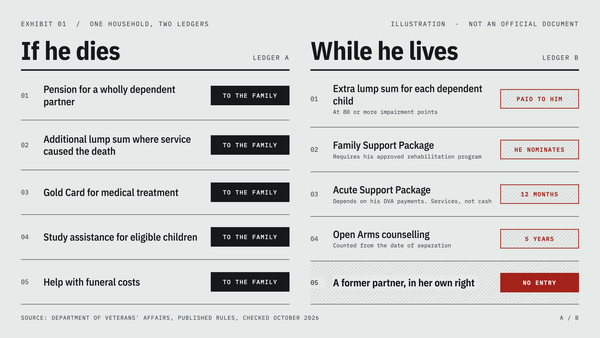
You have read what happened. You know what the drugs were, what they did, and why the families of the soldiers who took them have been waiting for more than twenty-five years for a response proportionate to the harm. You know what the Royal Commission found, what it did not find, and where the gap between those two things sits.
The question this article addresses is the one that follows all of that: what do you do with it?
The families documented in this series do not need sympathy. They need action — from journalists, policymakers, clinicians, lawyers, advocates, and members of the public who are willing to use whatever they have to move the institutions that have looked away for a quarter of a century. Named failures, placed in evidence before the institutions responsible for them, have a history of eventually being answered. The evidence is here. The naming has been done. What remains is the decision — by people with power — to act.
This article tells you how.
The most important action for everyone
The single most powerful thing most people can do is ensure this series reaches people with the authority and platform to act on it.
Share it with your local federal Member of Parliament. Share it with a journalist. Share it with a lawyer, a doctor, a domestic violence service, or a researcher. Share it with anyone you know who has a connection to the ADF, to the veterans' affairs system, to the family law system, or to the domestic violence sector.
The families documented here have been invisible for twenty-five years. Visibility, in the right places, changes things. Not immediately, and not without sustained pressure, but it changes them. The evidence base for this series is solid. What it needs is the amplification that puts it in front of people who can act on it.
If you are a Member of Parliament or Senator
Ask the question on the record.
A question in the Senate or House of Representatives asking the Minister for Veterans' Affairs specifically why spouses and children of ADF quinoline trial veterans are excluded from the Royal Commission's brain injury program — and what the timeline is for addressing that exclusion — places the issue on the parliamentary record and requires a ministerial response. Questions on notice cost nothing. They create accountability. They generate a paper trail. They signal to the affected community that someone in the parliament has noticed.
The specific questions worth asking are these. Why are spouses and children of ADF quinoline trial veterans excluded from the brain injury program recommended by the Royal Commission? What is the timeline for extending recognition and support to this population? What research has been commissioned into domestic violence and child harm outcomes in the quinoline veteran cohort? What is the government's response to the duty of care argument for families of clinical trial subjects?
The evidentiary record needed to frame those questions is in this series, in the Senate inquiry submissions, and in the Royal Commission's Volume 4, Chapter 22.
If you are a journalist
Investigate and publish.
The evidentiary record is available and verifiable. The peer-reviewed literature is publicly accessible. The Senate inquiry report and its submissions are on the Parliament of Australia website. The Royal Commission's final report is at defenceveteransuicide.royalcommission.gov.au. The FDA Drug Safety Communication on mefloquine is at fda.gov. Freedom of Information requests for AMI trial records, DVA correspondence on the SOP gap, and coronial records involving quinoline-era veterans are open to any journalist willing to file them.
The story has not been told at the scale it deserves. The Fort Bragg cluster in the United States — four soldiers killing their wives within six weeks of returning from Afghanistan in 2002, three subsequently dying by suicide — received significant media attention at the time. The Australian equivalent has not. The domestic harm documented in this series is as serious, as documentable, and as attributable to specific institutional decisions as any story the Australian investigative press has pursued in the veteran welfare space.
Contact Major Stuart McCarthy through the Quinoline Veterans and Families Association for on-record comment and access to the Senate submission evidence base. Seek comment from Professor Jane Quinn of Charles Sturt University — peer-reviewed neurotoxicologist and primary scientific source. Request comment from the Minister for Veterans' Affairs on the exclusion of spouses and children from the Royal Commission's brain injury program.
If you are a lawyer
Build the legal framework.
No Australian legal precedent currently exists for quinoline-related domestic harm as a recognised context in family law or compensation proceedings. The duty of care argument for families of clinical trial subjects is documented in this series and is legally arguable. When a government administers drugs to service personnel in formal clinical trials, it accepts a specific duty of care to those trial subjects. That duty extends to the foreseeable consequences of the injury those drugs may cause — including the consequences experienced by the families living with those injuries.
Test cases matter. Submissions to family courts incorporating the neurological evidence — specifically, evidence that the behaviour assessed in custody and parenting proceedings was driven in significant part by quinoline-induced acquired brain injury that was never correctly diagnosed or treated — would place this framework before the judiciary in a way that creates precedent.
Contact Legal Aid commissions about developing a quinoline-context module for family law practitioners. Contact the Defence and Veterans Legal Service — 1800 33 1800 — about coordinating on test cases. Consider pro bono representation for women seeking family court review on the basis of neurological evidence not before the original court.
If you are a clinician
Start with the history.
If you treat ADF veterans from the East Timor or Bougainville deployment period, ask about antimalarial drug use if you have not already. The question is simple: what antimalarial drugs were you given, and when? A veteran who received mefloquine or tafenoquine during this period and who presents with a neuropsychiatric profile that has not responded adequately to PTSD-focused treatment deserves to have that history examined.
Refer veterans for CYP2D6 testing where quinoline toxicity is a plausible contributor. Evidence suggests that individuals with poor or intermediate CYP2D6 enzyme function may be unable to clear quinoline compounds from the brain before toxic concentrations accumulate. This is a plausible and clinically actionable line of investigation in a population that has been treated for the wrong condition for decades.
If you conduct parenting capacity assessments in family court proceedings involving ADF veterans from this deployment period, request and review military pharmaceutical records as part of your standard process. The absence of a quinoline history in the clinical file does not mean the history is absent. It may mean it was never recorded.
Familiarise yourself with the clinical presentation of quinoline-induced acquired brain injury and how it differs from PTSD on standard assessment. The peer-reviewed literature — particularly Ritchie, Block and Nevin (2013) and Nevin (2014, 2016) — provides the clinical foundation.
If you are a researcher
The most significant evidentiary gap in this field is also the most open research opportunity.
No longitudinal health study has ever been conducted on the ADF personnel who participated in the mefloquine and tafenoquine trials of 1998–2002. No research exists on domestic violence and family harm outcomes in the quinoline veteran cohort. No clinical protocol has been developed for assessing quinoline-related neurological risk in family court proceedings. No validated diagnostic tool exists for distinguishing quinoline-induced acquired brain injury from PTSD in individuals with both combat exposure and drug exposure.
Each of these gaps is an opportunity for a researcher or institution to produce the evidence that the policy argument requires — and that the affected families deserve. Collaboration with the QVFA, Professor Jane Quinn, and domestic violence research centres would provide access to the affected population. ARC and NHMRC funding applications targeting this population are currently uncontested in this specific domain.
If you are a domestic violence practitioner
Develop a quinoline-specific framework.
No domestic violence service in Australia currently has a protocol for identifying, assessing, or supporting women affected by quinoline-related harm. The features that distinguish this population from the standard coercive control population are documented in this series — the neurological origin of the behaviour, the episodic nature of the risk, the veteran context, the specific implications for safety planning and risk assessment when the perpetrator's harmful behaviour is produced in significant part by an acquired brain injury.
Those features are sufficient to form the basis of a training module and a risk assessment addendum. Contact the QVFA for access to the advocacy evidence base. Contact domestic violence research centres about developing a clinical protocol. Raise this with your peak body.
If you are a policymaker
The Royal Commission's Recommendation 61 — a dedicated brain injury program for veterans exposed to mefloquine and tafenoquine — has been accepted by the Australian Government. The implementation of that program is the immediate policy priority for veterans. But the families are outside its scope, and that exclusion is not a minor gap. It is a structural failure in a response that was otherwise a significant step forward.
The policy pathway for including families exists. It requires an amendment to the Veterans' Entitlements Act and the Military Rehabilitation and Compensation Act to create an entitlements pathway for family members harmed as a foreseeable consequence of ADF clinical drug trials. It requires a cross-departmental working group — DVA, Attorney-General's, Health, and Social Services — to design the support program that recognition requires. It requires the Repatriation Medical Authority to develop a Statement of Principles for quinoline-induced acquired brain injury, with appropriate neurotoxicology expertise, that covers the integrated syndrome rather than its individual symptoms. And it requires a formal, public, unconditional apology to the families — not as a political gesture, but as the beginning of an accurate account.
Commission an independent legal opinion on the Commonwealth's duty of care to families of clinical trial subjects. The argument is made in this series. A formal legal opinion would give it the institutional standing that policy decisions require.
Write to your Member of Parliament
A constituent letter on a specific, documented issue is one of the most effective forms of political advocacy available to a member of the public. You do not need to be an expert. You need to be a constituent who has read this series and wants to know what the government is doing about it.
The following template is available for you to use or adapt.
Dear [Member's Name],
I am writing as a constituent to raise an urgent matter concerning the families of ADF veterans who were administered the quinoline antimalarial drugs mefloquine and tafenoquine during deployments to East Timor and Bougainville between 1998 and 2002.
The Royal Commission into Defence and Veteran Suicide recommended a brain injury program for affected veterans. The Australian Government agreed to this recommendation in principle and referred it to a taskforce for further advice. However, the spouses, partners, and children of these veterans — who bore the domestic consequences of neurological injuries caused by government-administered drugs — have been entirely excluded from this program and from any form of recognition or support.
These families are the secondary casualties of a government drug trial they never consented to and were never told about. Many have experienced severe domestic violence, financial devastation, loss of custody of their children, and lifelong health consequences. No policy pathway exists for them. No research has been commissioned to document their situation. No apology has been made.
I am asking you to raise this matter with the Minister for Veterans' Affairs and to seek specific answers to the following questions. Why are spouses and children of ADF quinoline trial veterans excluded from the brain injury program? What is the timeline for extending recognition and support to this population? What research has been commissioned into domestic violence and family harm outcomes in this cohort?
I would be grateful for your response and for any action you are able to take on behalf of these families.
Yours sincerely,
[Your name]
[Your suburb and postcode]
"Copy the text above and adapt as needed."
To find your federal Member of Parliament, visit aph.gov.au and use the member search.
Key contacts
- Quinoline Veterans and Families Association — the primary advocacy organisation for this issue. Contact for access to Senate Submission 94 and for connection to affected veterans and families.
- Professor Jane Quinn, Charles Sturt University — peer-reviewed neurotoxicologist and primary scientific expert on the neurological mechanisms documented in this series.
- Defence and Veterans Legal Service — free legal support for veterans and families. Phone 1800 33 1800.
- Royal Commission Final Report, Volume 4, Chapter 22 — publicly available at defenceveteransuicide.royalcommission.gov.au.
If you or someone you know needs support: Open Arms 1800 011 046 · Lifeline 13 11 14 · 1800RESPECT 1800 737 732
Related reading
- Previous in the series: The Children
- Next in the series: If This Is Your Story
- Reporting Years Later: How Time Limits Work in Five Countries
Part of Unacknowledged Casualties. Read the full series at /unacknowledged-casualties/
Correction, 5 October 2026: This article originally said the Government accepted the Royal Commission’s brain injury program recommendation. The Government’s published response was “agree-in-principle”, with the recommendation referred to a taskforce. The sentence has been corrected.