After the Marriage Ends: What Follows a Former Defence Spouse, and What Does Not
The Royal Commission’s family recommendations help a woman leave safely. One former army wife sets out what she lost afterwards, and what help existed for each loss.
Versión en español: Cuando termina el matrimonio
Related reading: What the Royal Commission Said About Families, and Who It Left Out, I Was Never Asked, What the Record Would Not Hold and Paid If He Dies.
Introduction
The Royal Commission into Defence and Veteran Suicide gave families their own chapter. Three of its recommendations, 102, 103 and 104, deal with family violence, family support and family advocacy. The Government agreed to all three.
I read them as a woman who spent twenty-one years with a soldier, recognised as his de facto partner from 1997 and married to him for seventeen of those years, and who is no longer married to him. The recommendations speak of Defence families, partners, veteran families and victims. In the text of those three recommendations, the words "former partner" do not appear.
This article is about what that omission looks like from the inside. I set out what I lost when the marriage ended and, beside each loss, what help existed. It is one case. I do not offer it as proof of how often this happens. I offer it because no one is counting, and a single case is what remains when there is no count.
Development
What the recommendations cover
Recommendation 102 is about family and domestic violence. It makes the safety of victims, including children, the first consideration in Defence decisions. It deals with protection orders in the workplace, with access to emergency services on base, and with housing: Defence housing is not to be used to create "barriers to safe separation".
Defence Families of Australia, whose issues paper the recommendation tells Defence to implement, goes a step further. Its own summary of that paper lists a removal for the civilian partner when a relationship breaks down, and a better rental reference letter to help ex-partners find private housing.
These are real measures. They concern the weeks around leaving.
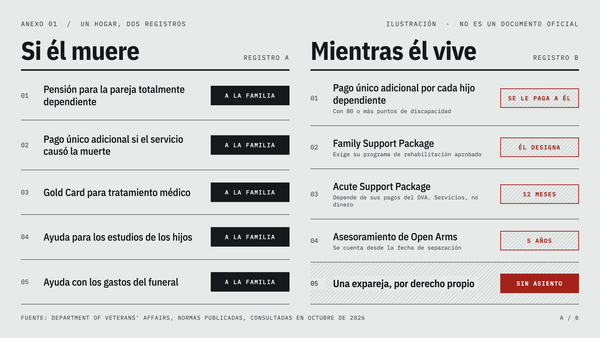
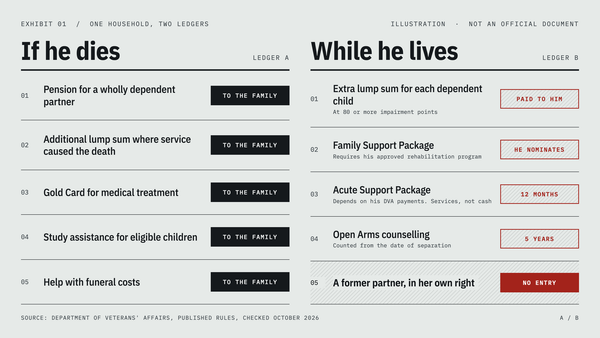
One service states its rule for former partners in plain terms. Open Arms, the counselling service for veterans and families, lists former partners as eligible within five years of separation, or while co-parenting a child under 18 with the member.
That is the map. What follows is the ground.
What ended with the marriage
My marriage ended in 2017. We were living in Mexico with our four children. He left.
My children. In 2018 I arranged emergency flights home through the embassy. Within days, on the strength of two reports, a child protection service placed all four children with their father. No statement was taken from me. I have been separated from them for eight years. Recommendation 102 makes the safety of children the first consideration in Defence decisions. This decision was not made by Defence, and I have found nothing in the three recommendations that reaches it.
My home. I became homeless after my children were taken from me. I spent most of the years that followed in Mexico, much of that time without a home. The housing measures concern Defence housing and the move out of it. There was no Defence house to leave.
Money. After he left, about US$14,200 arrived in small, irregular transfers. The household contents stayed in storage under his control. I did not contest any of it. I had nothing left to contest it with. I have found no measure addressed to this.
The people I knew. Our friends did not stay. They took his side and believed his version of events, including a friend I had known since school. That is my account. I cannot source it, and I know of no study that measures it. No program restores a community. It is the reason the other forms of support matter more, not less.
My health. I live with complex post-traumatic stress, anxiety and depression. The Open Arms window for a former partner ran for five years from separation. Mine closed in 2022. After my children were taken from me in 2018, I was homeless, for much of that time in another country. I did not know the rule existed until after my window had closed. When I did ask Open Arms for help, years later, they were helpful. That shows a service can be flexible. Not all of them are, and a woman in an unusual situation should not have to depend on finding one that is. Whether a mother with no care of her children is "co-parenting" is not something the rule says.
A place in the record. The one study of East Timor families received 24 questionnaires from former partners and left them out of its results. The larger 2015 research programme excluded former partners altogether. The figures are set out in I Was Never Asked.
Analysis
Three observations follow.
First, eligibility follows the relationship, not the harm. A woman is a Defence partner for as long as she is married to the member. What happened to her during those years does not keep her inside the definition once the marriage is over. Where violence is the reason the marriage ends, the way out of the marriage is also the way out of support. Defence recognised me as his de facto partner in 1997, three years before we married. For more than twenty years I was, in its own records, family. That recognition ended when the marriage did.
Second, the clock runs from the wrong date. Five years from separation assumes that separation is where the harm stops and recovery begins. In my case the largest losses came after it: my children the following year, my housing, and then my health. The window was open during the years I was least able to reach it.
Third, nothing is counted. I do not claim my case is typical. I claim that no one can tell me whether it is. No agency records what becomes of a former spouse, and research has reached her only through the member, or not at all. An outcome that is never recorded can always be described as rare.
None of this depends on why a marriage ends or on who ended it. It depends only on how eligibility is defined.
What I am asking for
- That former partners be named. When Recommendations 102, 103 and 104 are carried out, "family" should expressly include former partners, in particular where the separation followed family violence.
- That support not expire on a clock set at separation. Counselling and practical help should remain open to former partners who experienced family violence during the member’s service. Where a service already uses discretion to help, that discretion should be written into the rules, so that it does not depend on who answers the phone.
- That former partners be counted. Research should recruit them directly, not through the member, and should record what happened after the marriage ended.
I have put related questions to the Veteran Family Commissioner. Those letters, and the replies when they come, are recorded in What the Royal Commission Said About Families, and Who It Left Out.
Conclusion
The recommendations describe how to help a woman leave safely. They are silent on what her life is afterwards. This is the record of one such afterwards. It should not be the only one written down.
If you need support. Australia: Open Arms 1800 011 046 · 1800RESPECT 1800 737 732 · Lifeline 13 11 14. New Zealand: Emergency 111 · Women’s Refuge 0800 733 843 · 1737 (call or text).
Sources
- Royal Commission into Defence and Veteran Suicide, Final Report, 9 September 2024 — Volume 6, Chapter 27, Recommendations 102, 103 and 104.
- Open Arms – Veterans & Families Counselling, Eligibility matrix — former partners: within five years of separation, or while co-parenting a child under 18.
- Defence Families of Australia, Advocating for Defence families on Domestic and Family Violence prevention — summary of its issues paper and 23 recommendations.
- University of Queensland, Centre for Military and Veterans’ Health, for the Department of Veterans’ Affairs, Timor-Leste Family Study (2012).