Versión en español: Bajas no reconocidas
A ten-part public-interest research series examining the ADF quinoline antimalarial drug trials of 1998–2002, the neurological injuries they caused, and the spouses and children who lived with the consequences for more than twenty-five years without recognition or support.
Article 1: Unacknowledged Casualties: The ADF Quinoline Drug Trials and the Families Left Behind is a ten-part public-interest research series based on a comprehensive report of the same title, prepared in 2026 for investigative, policy, and advocacy purposes.
The Quinoline Era
1,540 Australian soldiers were given an unregistered antimalarial. 1,157 more got six times the approved mefloquine dose. No follow-up was ever done.
 Jacqualine Roche
Article 2: This series begins with the drugs — mefloquine and tafenoquine, both developed by the United States Army, both belonging to the quinoline chemical class, both carrying a neuropsychiatric adverse-effect profile now documented in regulatory labelling and peer-reviewed literature. It ends with the families who lived with the consequences. Start with Article 1: The Quinoline Era.
About This Series
How this series uses evidence, who its primary sources are, what standing they hold, and where the record runs out. The methodology page for Unacknowledged Casualties.
 Jacqualine Roche
Article 3: For years, families living with the consequences of ADF quinoline drug trials were given the wrong explanation. The clinical system called it PTSD. The legal system called it character. This article names what it actually was — and why the distinction matters for veterans, partners, families, and every institution that assessed the behaviour without the neurological framework to understand it.
It Was Not His Personality. It Was His Brain.
The behaviour looked like narcissism. It was an acquired brain injury with a documentable onset date — and the difference changes what the harm means.
 Jacqualine Roche
Article 4: Coercive control is well documented. What the standard frameworks were not designed for is a household in which the controlling behaviour originates in pharmacological injury to the brain. This article documents what that looked like — the patterns, the mechanism behind each one, and why the episodic nature of the harm made it the hardest kind to name, prove, or survive.
Coercive Control in the Home
How mefloquine and tafenoquine created the neurological conditions for coercive control — and why the standard domestic violence frameworks did not reach these families.
 Jacqualine Roche
Article 5: This is the first-person article in the series. Everything documented across the first four articles — the drugs, the neurological mechanism, the coercive control, the institutional failures — this article places inside a single household. It is not a memoir in the conventional sense. It is a forensic account of what it cost to live inside a government drug trial's consequences without a name for what was happening, and what it means to finally have one.
Just the Army Wife
A first-person account of living inside the unrecognised consequences of government-administered neurotoxic drugs — and what it means to finally understand where responsibility sits.
 Jacqualine Roche
Article 6: The structural argument at the centre of the series. Approximately 3,000 ADF personnel were administered quinoline drugs between 1998 and 2002. Zero formal support programs have been established for their spouses or children. This article documents why that gap exists, why it has persisted across twenty-five years and four countries, and what closing it actually requires.
Left Behind
2,859 ADF personnel were given tafenoquine or mefloquine in Army Malaria Institute trials. Zero support programs exist for their spouses or children.
 Jacqualine Roche
💡
Article 7: The most direct article in the series. It does not soften what happened. Written for the women who lost the most — the legal battle, the children, the financial security — it traces the chain of institutional failures that brought them there, names what they are living with now, and states plainly what they need. Not charity. Restitution
She Was Left With Nothing
For the women the system forgot entirely — the chain of failures that brought them here, what they are living with now, and what they actually need.
 Jacqualine Roche
Article 8: The children did not deploy. They did not consent to anything. They grew up in households shaped by a parent's neurological injury, carrying what they witnessed and internalising what they could not name. This article documents what they were exposed to, what the research predicts, and the most concrete harm of all — that they were never told the truth about what had happened in their own home.
The Children
What happened to the children who grew up in ADF quinoline veteran households — what they were exposed to, what the research shows, and what the silence cost them.
 Jacqualine Roche
Article 9: The action article. The families documented in this series do not need sympathy — they need action. This piece sets out, by role, exactly what journalists, MPs, lawyers, clinicians, researchers, domestic violence practitioners, and members of the public can do — including a constituent letter template anyone can use. The evidence is here. The naming has been done. What remains is the decision to act.
What You Can Do
Precisely how journalists, lawyers, clinicians, policymakers, and members of the public can act on what this series documents.
 Jacqualine Roche
Article 10: The last article, and the one written directly to the people the series is for. Not for institutions, not for professionals — for the partners, former partners, and adult children who recognise their own lives in these pages. It offers what no institution has: an acknowledgement, without hedging, that what happened was real, that it was not their fault, and that they were never meant to carry it alone.
If This Is Your Story
For partners, former partners, and adult children of ADF quinoline veterans who recognise their own experience. You did not imagine it. It was not your fault.
Jacqualine Roche
Companion document: a clinical, social and forensic profile of the partners and spouses of affected veterans, with a full evidential register. Read alongside the series, or on its own.
The Spouse: A Clinical and Social Profile
Partners and spouses of ADF veterans with quinoline-induced neurological injury — a clinical, social, and forensic record.
 Jacqualine Roche
Note on the figures
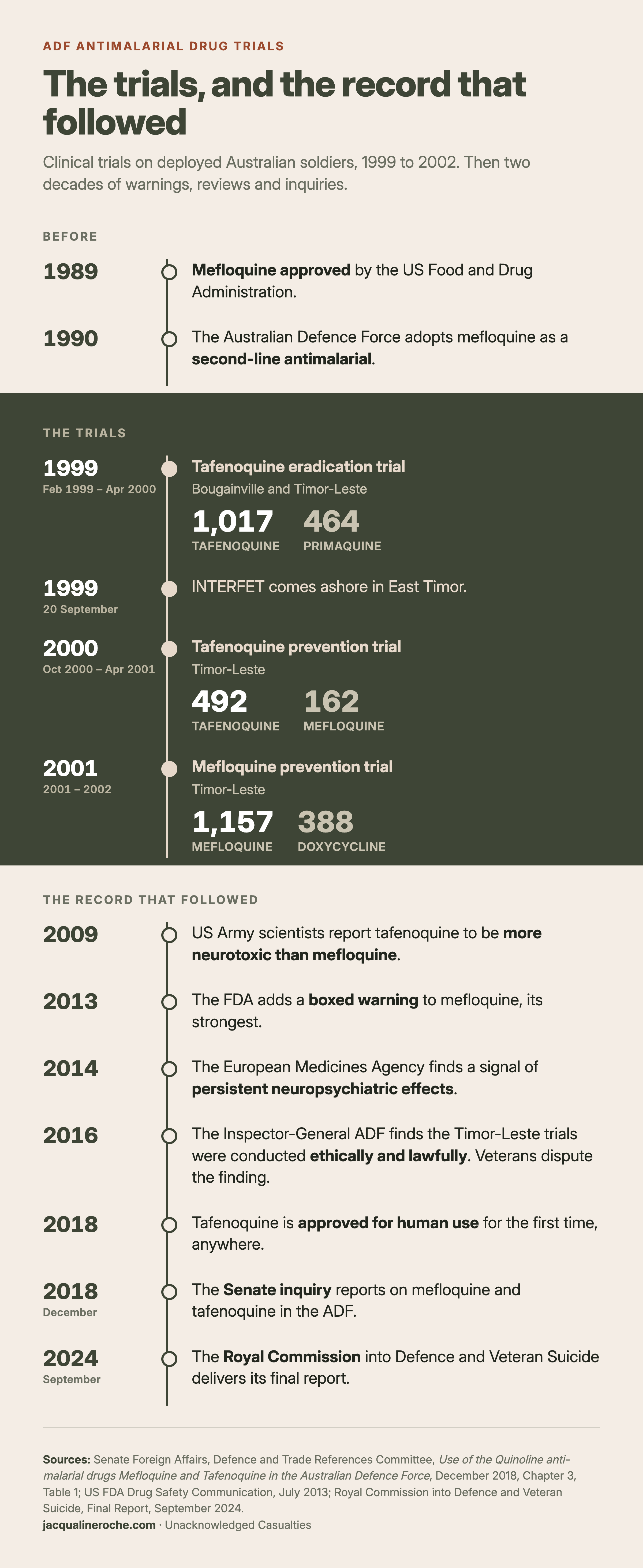
The trial numbers in this series come from the Department of Defence's own record of the Army Malaria Institute studies, as reproduced in the 2018 Senate inquiry report.
- Tafenoquine: 1,540 personnel. 1,017 in the 1999–2000 eradication study (Bougainville and Timor-Leste), 492 in the 2000–01 prevention study (Timor-Leste), and 31 in a 2000–01 treatment study in Australia.
- Mefloquine in the trials: 1,319 personnel. 1,157 in the 2001–02 prevention study (Timor-Leste), and 162 in the comparator group of the 2000–01 tafenoquine prevention study.
- Tafenoquine or mefloquine in the trials: up to 2,859 personnel (1,540 + 1,319), described in this series as "nearly 3,000". Some people may have taken part in more than one study.
- All trial participants: 3,711, including the comparator groups given primaquine (464) or doxycycline (388).
- 3,523 is a wider figure. The Senate committee's maximum combines everyone who took either drug in the studies with mefloquine prescribed to ADF members outside the studies since 2001. The committee noted it is "likely" an overestimate because the groups may overlap.
Sources
- Senate Foreign Affairs, Defence and Trade References Committee, Use of the Quinoline anti-malarial drugs Mefloquine and Tafenoquine in the Australian Defence Force, Chapter 3, December 2018 — paragraphs 3.28–3.29 and Table 1.
- Department of Defence, Antimalarial medications — trial participant numbers by study.