What Does "Institutional Silence" Mean? Seven Examples From One Family
The heading on this site says "an independent record of institutional silence". Here is what that means, in plain words, with seven examples and where to get help.


Versión en español: ¿Qué es el silencio institucional?
Introduction
The heading on this website says: An independent record of institutional silence. Those words can sound abstract. This page explains what they mean, using seven examples from my own story.
Institution means an organisation with responsibility for people: the army, government departments, the courts, child protection services, embassies, and the researchers paid to study families.
Silence means that the institution did not ask, did not write it down, did not answer, or did not act. It does not usually mean a cover-up. Most often it means that something was nobody’s job.
Independent means this record is not funded by, and does not answer to, any of those organisations. I write it myself.
Seven examples
1. Nobody followed the soldiers
Between 1999 and 2002, the Australian Defence Force gave soldiers antimalarial drugs in clinical trials. Participants were monitored during deployment and for some months afterwards. No long-term health study of them has ever been done.
Read more: The ADF Antimalarial Drug Trials: A Timeline
2. Nobody asked the wives directly
The one study of families of soldiers who served in East Timor reached wives and partners only through the soldier. If he did not pass on her details, she was never asked. Former partners’ answers were left out of the results.
Read more: I Was Never Asked
3. "You’ll ruin his career"
There was violence in our home, and the police and the army knew. I was told many times that pressing charges would ruin his career. Counselling was arranged each time. The violence was managed, but it was never counted.
Read more: “You’ll Ruin My Career”
4. Nobody took my statement
In 2018, within days of two reports, a child protection service placed my four children with their father. No one asked for my side. I had a lawyer’s documents ready. No one asked for them.
Read more: What the Record Would Not Hold
5. Help that started something else
The embassy did what it is meant to do: it helped a citizen in trouble get home. It also contacted my children’s father. No organisation was responsible for what happened next.
Read more: What a Consulate Can and Cannot Do
6. A report that does not name us
The Royal Commission into Defence and Veteran Suicide made recommendations to support Defence families. In those recommendations, the words "former partner" do not appear.
Read more: What the Royal Commission Said About Families
7. A clock that ran out
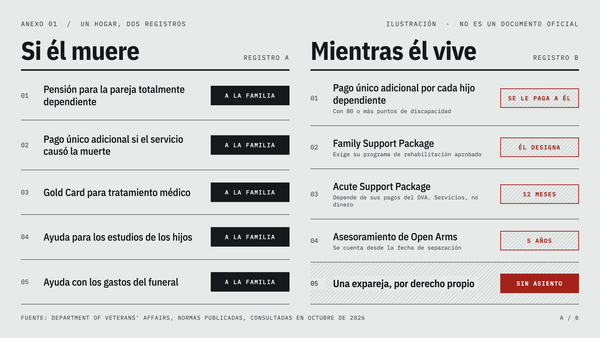
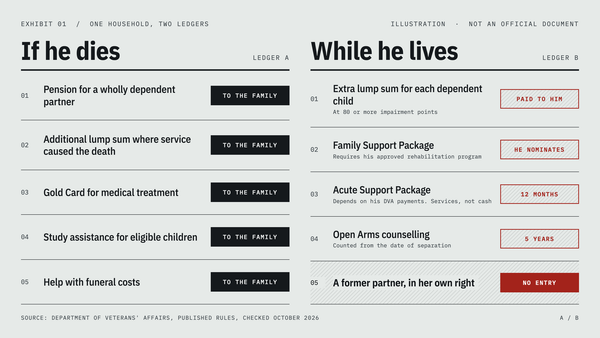
A former partner can use the veterans’ counselling service for five years after separation. I did not know that rule existed until my five years had passed. When I asked years later, they still helped me. Not every service is that flexible.
Read more: After the Marriage Ends
What the examples have in common
In almost every example, each organisation did its own job. The army ran its trials. The researchers ran their study. The child protection service acted on the reports it received. The embassy arranged flights.
What no one did was hold the whole story. The silence is in the gaps between them.
That silence has a cost. What is never written down cannot be counted. What cannot be counted can always be called rare. And what is called rare does not get a program, a budget or an apology.
I am not saying that everyone acted badly. I am saying that no one was responsible for seeing the whole picture, and so no one did.
If this sounds familiar
- Write it down. Dates, names, what was said, who was there. A short note made at the time is worth more than a long memory later.
- Ask for your own records. In Australia you have the right to ask government agencies for the information they hold about you. The Office of the Australian Information Commissioner explains how, and how freedom of information requests work.
- Ask one question. "Whose job is this?" If no one can answer, that is worth writing down too.
- Keep copies. Of letters, emails, forms and replies, including the ones that say no.
Where to get help
Australia: Open Arms (veterans and families) 1800 011 046 · 1800RESPECT 1800 737 732 · Lifeline 13 11 14 · Defence and Veterans Legal Service 1800 33 1800
New Zealand: Emergency 111 · Women’s Refuge 0800 733 843 · 1737 (call or text, free, 24 hours)
Sources: Office of the Australian Information Commissioner, Access your personal information and On accessing information under freedom of information. Every example on this page is set out in full, with its own sources, in the article linked beneath it.