The ADF Antimalarial Drug Trials: A Timeline, 1999–2024
From the first tafenoquine study in 1999 to the Government’s response to the Royal Commission in 2024: every key date in the ADF antimalarial drug trials, with sources.

Versión en español: Los ensayos de antipalúdicos de la ADF: una cronología, 1999–2024
Between 1999 and 2002 the Australian Defence Force gave two antimalarial drugs, mefloquine and tafenoquine, to soldiers in clinical trials during and after deployments to Bougainville and East Timor. What followed took twenty-five years and is still not finished.
This page sets the events out in order, with a source for each. It is a reference for the rest of the Unacknowledged Casualties series. It does not argue a case. Where the record is disputed, it says so.
The trials, 1999–2002
The studies were run by the Army Malaria Institute. The Department of Defence records four of them.
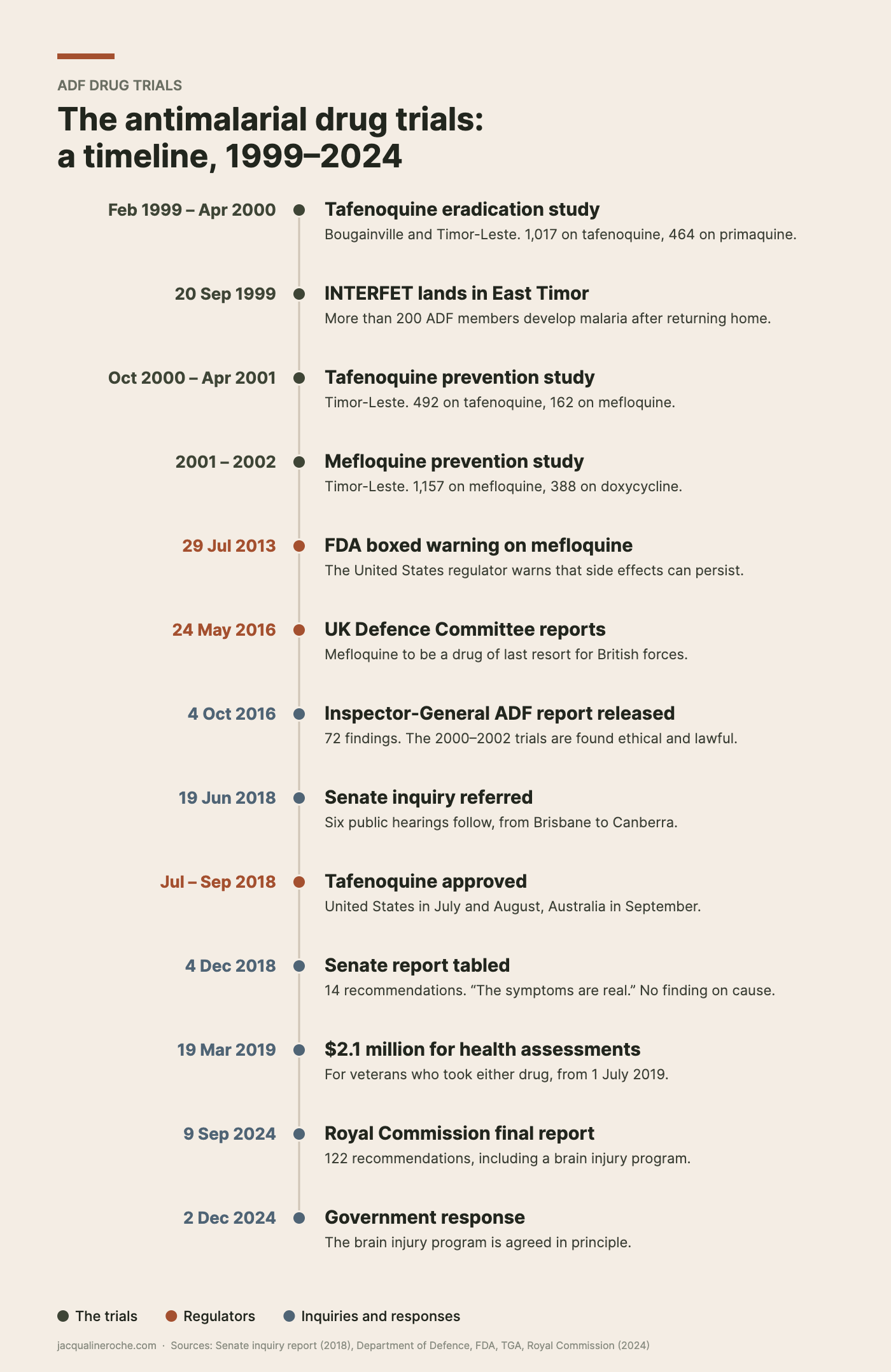
- February 1999 to April 2000: tafenoquine eradication study. Bougainville and Timor-Leste. 1,017 personnel took tafenoquine and 464 took primaquine, the standard drug, to clear malaria parasites after deployment.
- October 2000 to April 2001: tafenoquine prevention study. Timor-Leste. 492 personnel took tafenoquine and 162 took mefloquine as the comparison drug.
- 2000 to 2001: tafenoquine treatment study. Australia. 31 ADF members with confirmed relapsing malaria.
- 2001 to 2002: mefloquine prevention study. Timor-Leste. 1,157 personnel took mefloquine and 388 took doxycycline.
Mefloquine had been registered in Australia since 27 January 1993. Tafenoquine was not registered anywhere in the world at the time of the trials.
The trials ran alongside a real malaria problem. INTERFET landed in East Timor on 20 September 1999. The Senate committee later recorded that 64 ADF members were infected during that deployment and more than 200 developed malaria after they came home.
The committee put the largest possible number of ADF members who took either drug at 3,523: up to 1,983 on mefloquine and 1,540 on tafenoquine. It noted that the figure is probably too high, because one person could appear in more than one study.
What regulators overseas said
- 29 July 2013. The United States Food and Drug Administration added a boxed warning, its strongest, to mefloquine. It said neurological and psychiatric side effects could persist after the drug was stopped.
- 24 May 2016. The House of Commons Defence Committee in the United Kingdom published An acceptable risk? The use of Lariam by military personnel, and said the drug should be considered only as a last resort.
- 20 July and 8 August 2018. The FDA approved tafenoquine in two forms, Krintafel and Arakoda.
- 12 and 13 September 2018. Australia's Therapeutic Goods Administration approved tafenoquine as Kozenis and Kodatef. This was sixteen years after the last ADF trial ended.
The inquiries
22 August 2016. The ABC’s 7.30 program reported that the ADF had admitted a soldier with a history of mental illness should not have been included in one of the East Timor trials. Watch the report on the ABC.
Inspector-General of the ADF, 2016
After complaints about the conduct of the trials, the Inspector-General of the Australian Defence Force examined the studies carried out in East Timor from 2000 to 2002. The report was released on 4 October 2016 with 72 findings and three recommendations. It found the trials were conducted ethically and lawfully. Veterans who took part, and their advocates, dispute that finding.
Medical review bodies, 2017 and 2018
In August 2017 the Repatriation Medical Authority found there was not enough evidence that mefloquine or tafenoquine cause acquired brain injury. In September 2018 the Specialist Medical Review Council reached the same view.
The Senate inquiry, 2018
The Senate referred the matter to its Foreign Affairs, Defence and Trade References Committee on 19 June 2018. The committee held six public hearings between 30 August and 8 November, in Brisbane, Townsville, Canberra and Melbourne.
Its report was tabled on 4 December 2018 and made 14 recommendations. The committee accepted that the symptoms veterans described are real. It made no finding that the drugs caused them, and it did not reopen the Inspector-General's conclusions about how the trials were run.
The recommendations dealt with consent to future research, faster handling of claims, better information for veterans, and a neurocognitive health program.
What followed
- 19 March 2019. The Government announced $2.1 million over four years for comprehensive health assessments for veterans who had taken either drug, starting on 1 July 2019.
- 9 September 2024. The Royal Commission into Defence and Veteran Suicide delivered its final report: seven volumes and 122 recommendations. Recommendation 61 called for a brain injury program. The Commission said the program should cover serving and former members exposed to mefloquine or tafenoquine.
- 2 December 2024. The Government responded. It agreed, or agreed in principle, to 104 of the 122 recommendations. The brain injury program was agreed in principle and sent to a taskforce for further advice.
What the timeline does not contain
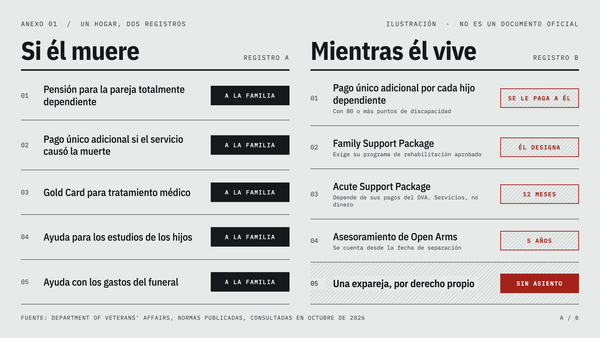
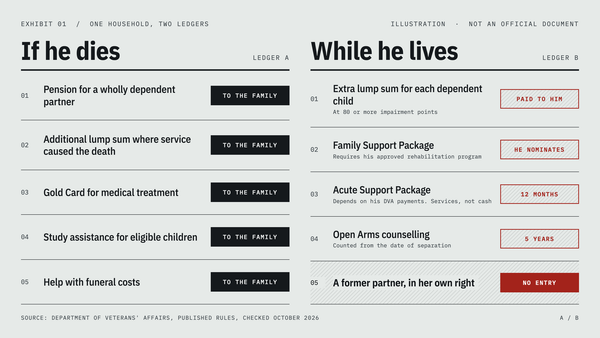
Every entry above concerns the soldier: what he was given, what he was told, what he can now claim.
There is no entry for the people who lived with him afterwards. I have found no study that followed the spouses or the children of trial participants. The Senate committee recorded that the work of seeking help often falls on family members, and recommended that matters raised by veterans and families at consultation forums be followed up. I have found no program created for the families themselves.
One study came close. The Timor-Leste Family Study (2012), run by the University of Queensland for the Department of Veterans’ Affairs, surveyed the partners of members who had deployed to Timor-Leste. It was not a study of the drug trials: it covered the families of members who deployed, not of trial participants, and it reached partners only through the member. About one in ten partners who responded screened positive for domestic violence. I set out what it could and could not show in I Was Never Asked.
That absence is the subject of this series. I was married to one of the soldiers who deployed in 1999 and again in 2001. My own account is in What the Record Would Not Hold. The missing families are counted, as far as they can be, in Left Behind and I Was Never Asked.
A note on the dates
The Department of Defence titles its own summary of these studies "1998–2002". That label places the start of the Bougainville study in 1998. The Senate report dates the first study from February 1999. This page follows the Senate report. The month-level dates for the first two studies come from Chapter 3, Table 1 of that report.
If a date here is wrong, see Corrections and Right of Reply.
Related reading
- The Quinoline Era
- What the Record Would Not Hold
- One Tablet
- I Was Never Asked
- What the Royal Commission Said About Families
Sources
- Senate Foreign Affairs, Defence and Trade References Committee, Use of the Quinoline anti-malarial drugs Mefloquine and Tafenoquine in the Australian Defence Force, 4 December 2018 — report, Chapter 1, Executive Summary, Chapter 5.
- Department of Defence, Antimalarial medications.
- Minister for Defence, Release of the IGADF report into complaints about the conduct of anti-malarial drug trials, 4 October 2016.
- ABC 7.30, ADF admits soldier shouldn’t have been included in East Timor anti-malaria drug trial, 22 August 2016.
- US Food and Drug Administration, Drug Safety Communication on mefloquine, 29 July 2013.
- House of Commons Defence Committee, An acceptable risk? The use of Lariam by military personnel, HC 567, 24 May 2016.
- Therapeutic Goods Administration, Australian Public Assessment Reports for Kozenis and Kodatef.
- FDA approval histories for Krintafel and Arakoda.
- Department of Veterans' Affairs, Assistance for veterans prescribed anti-malarial medications, Budget 2019–20.
- Royal Commission into Defence and Veteran Suicide, Final Report, 9 September 2024.
- Defence and Veterans' Service Commission, Royal Commission recommendations and Government responses.
- University of Queensland, Centre for Military and Veterans’ Health, for the Department of Veterans’ Affairs, Timor-Leste Family Study (2012) — Summary Report and Technical Report. Cited for what the study covered, not as a study of the trials.