Paid If He Dies: What Veterans’ Compensation Offers the Family That Lived With the Injury
Australia compensates a veteran for his injury and his family for his death. For a former partner harmed while he lives, the rules offer almost nothing.
Versión en español: Se paga si él muere
Related reading: After the Marriage Ends and What the Record Would Not Hold.
Introduction
Australia’s veterans’ compensation system has one set of payments for the veteran and another for his family. I went through the published rules to find out what exists for a family harmed by a service-related injury while the veteran is still alive.
This article sets out what I found, and then holds my own situation against each rule. It describes the rules as the Department of Veterans’ Affairs publishes them, checked in October 2026. It is not legal advice.
Development
What the family receives if he dies
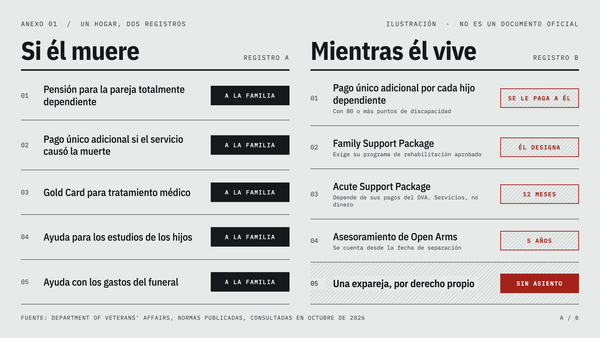
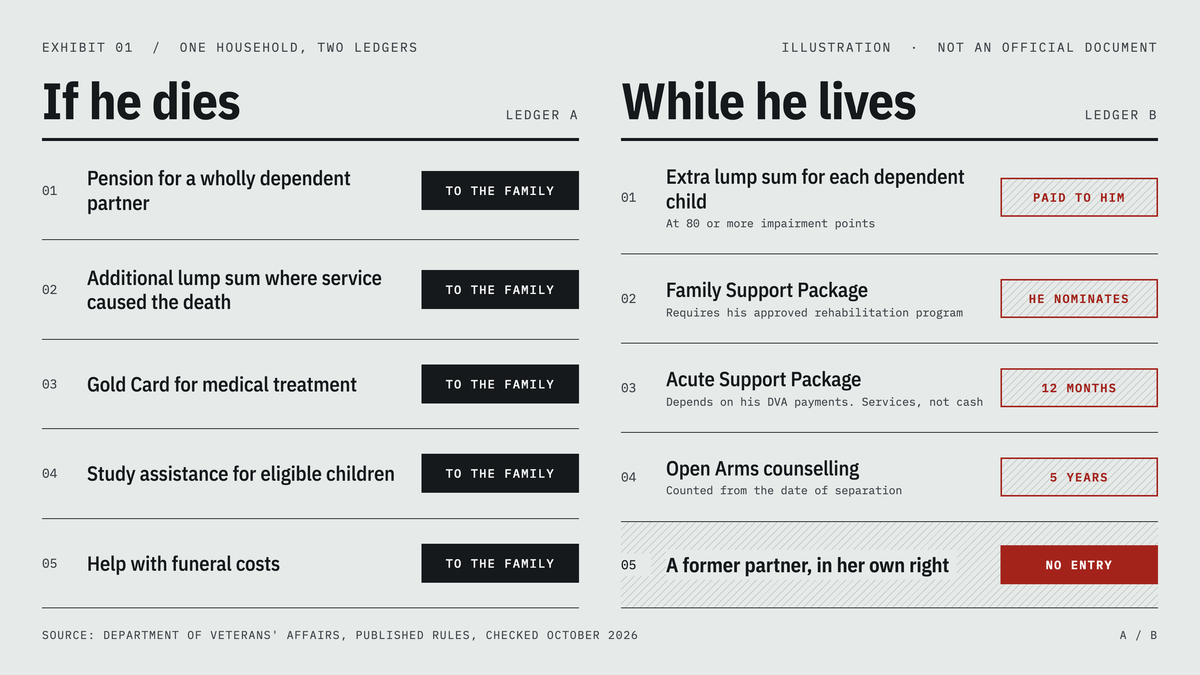
DVA describes its supports for dependants as being for family members of veterans who are deceased. They include:
- a pension for a "wholly dependent partner", which can be taken partly or wholly as a lump sum;
- an additional lump sum where the death was caused by service;
- a Gold Card for medical treatment;
- study assistance for eligible children;
- help with funeral costs.
From 1 July 2026, all new claims, including claims after a death, are assessed under one law, the Military Rehabilitation and Compensation Act.
Who counts as his partner
The test looks at the relationship immediately before the member’s death. A wife who is separated but still married is included. A former de facto partner is not. The definition covers a person who is "legally married to the member". A divorced former wife no longer is.
What exists while he is alive
- An extra lump sum for each dependent child, where the veteran is assessed at 80 or more impairment points. It is paid to the veteran, not to the child or the child’s mother. There is no equivalent for a partner.
- The Family Support Package. The veteran must be taking part in an approved rehabilitation program, and he nominates the family members who may use it. Former partners are not mentioned.
- The Acute Support Package. This one names former partners, but only if they separated within the previous 12 months or have a child under 18 living with them, and only if the veteran is receiving certain DVA payments. It pays for services such as counselling, childcare or household help, up to $7,500 in the first year and $5,000 in the second. It does not pay cash.
- Open Arms counselling. Available to a former partner within five years of separation, or while co-parenting a child under 18.
Held against my situation
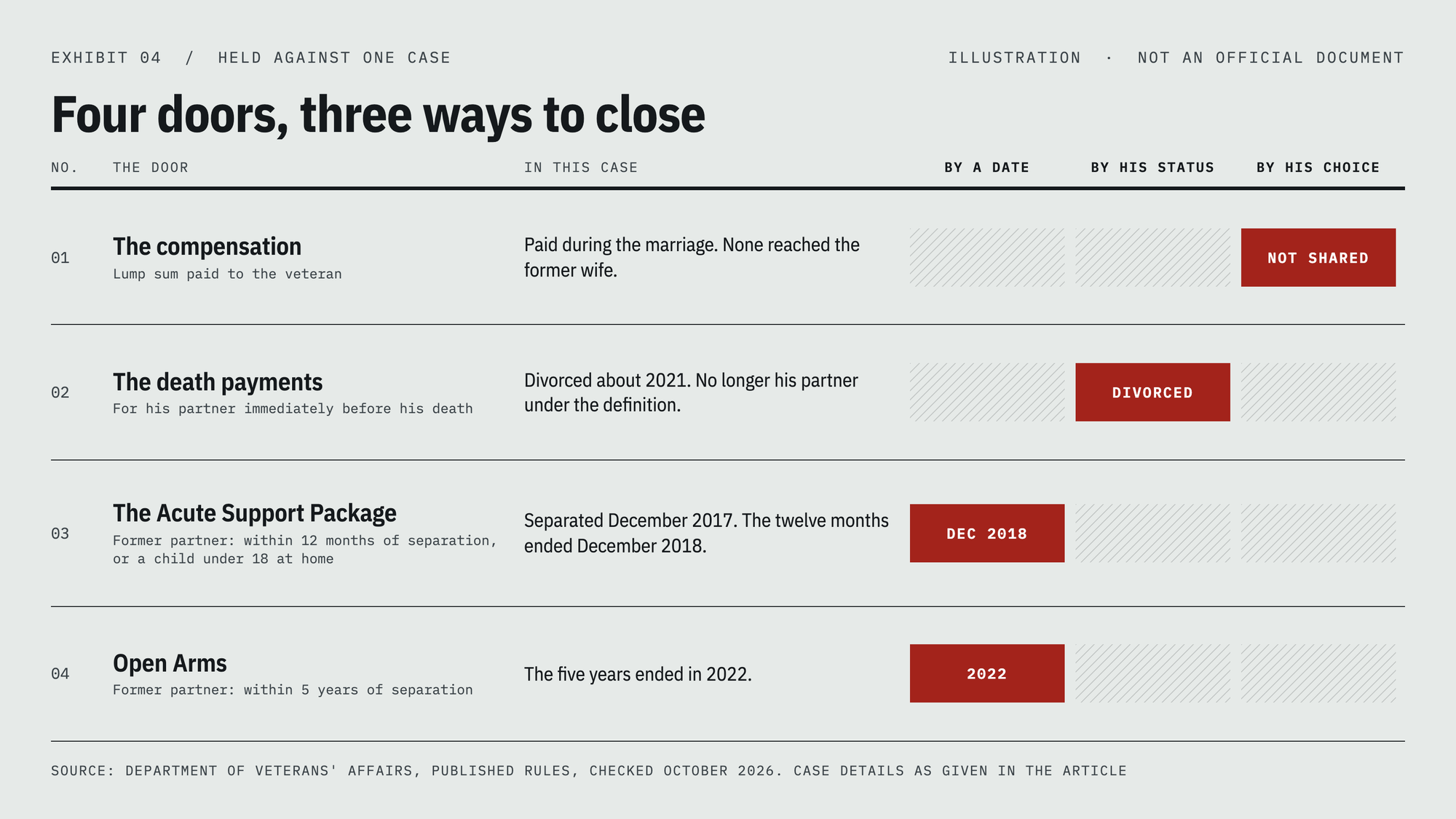
The compensation. My former husband received a significant lump-sum payment from DVA during our marriage. When the marriage ended, none of it came to me.
The death payments. Our divorce went through in about 2021. I was unwell and overseas at the time, and I was not notified. On the definitions above, I am no longer his partner, so none of the payments that follow a death would reach me.
The Acute Support Package. We separated in December 2017. My twelve months ended in December 2018. My children were taken from my care that year, so I had no child under 18 living with me.
Open Arms. My five years ended in 2022. I did not know the rule existed until afterwards.
Each door was closed in one of three ways: by a date, by his status, or by his choice.
Analysis
First, payments follow the injured body, not the household. The system compensates the veteran for his injury and compensates his family for his death. Harm the family suffers in between is not treated as harm to them. It becomes visible to the system only when he dies.
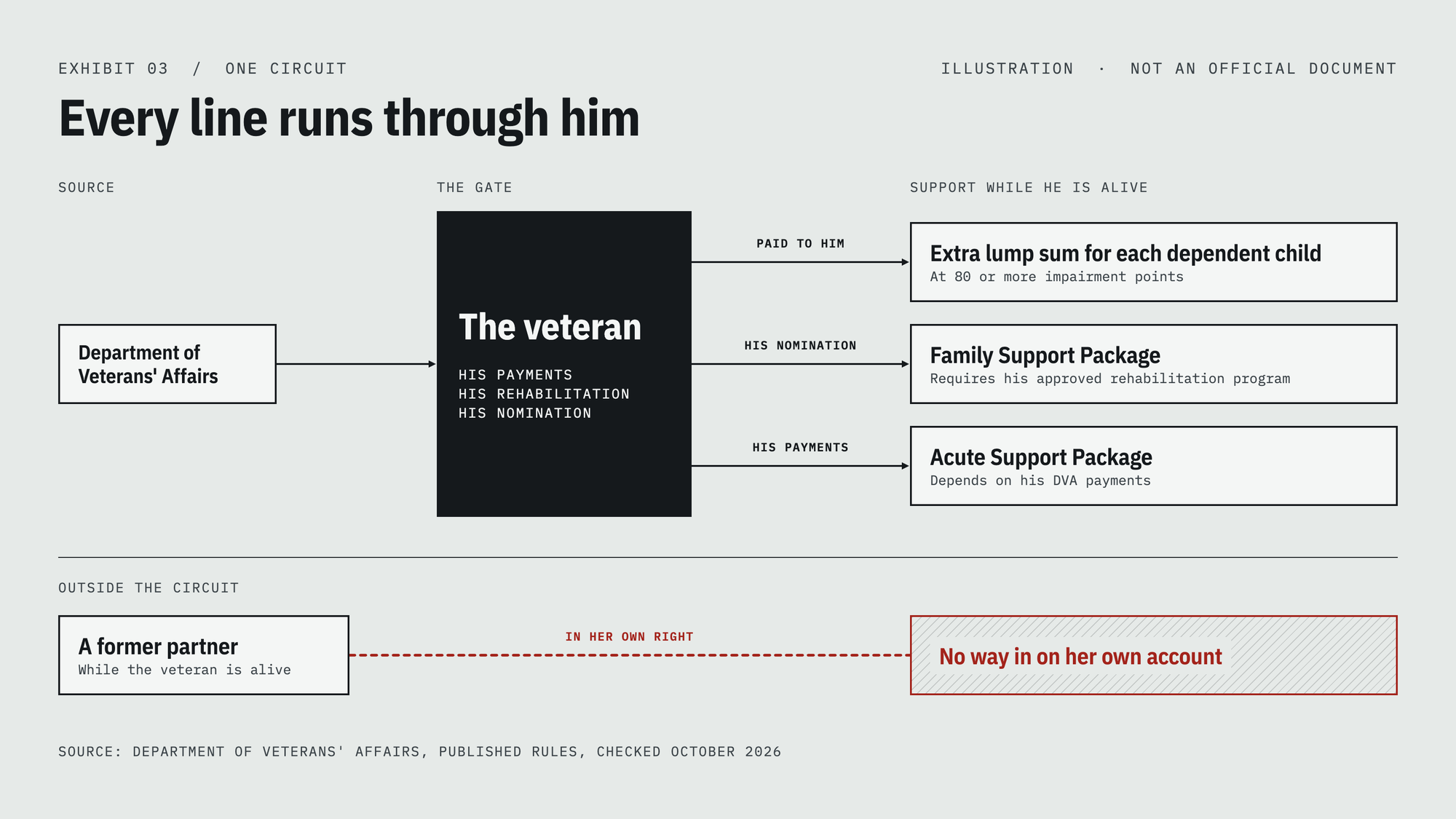
Second, help for the living family runs through him. It depends on his payments, his rehabilitation, or his nomination. In a household where there was family violence, the person whose status opens the door may be the person she needed protection from.
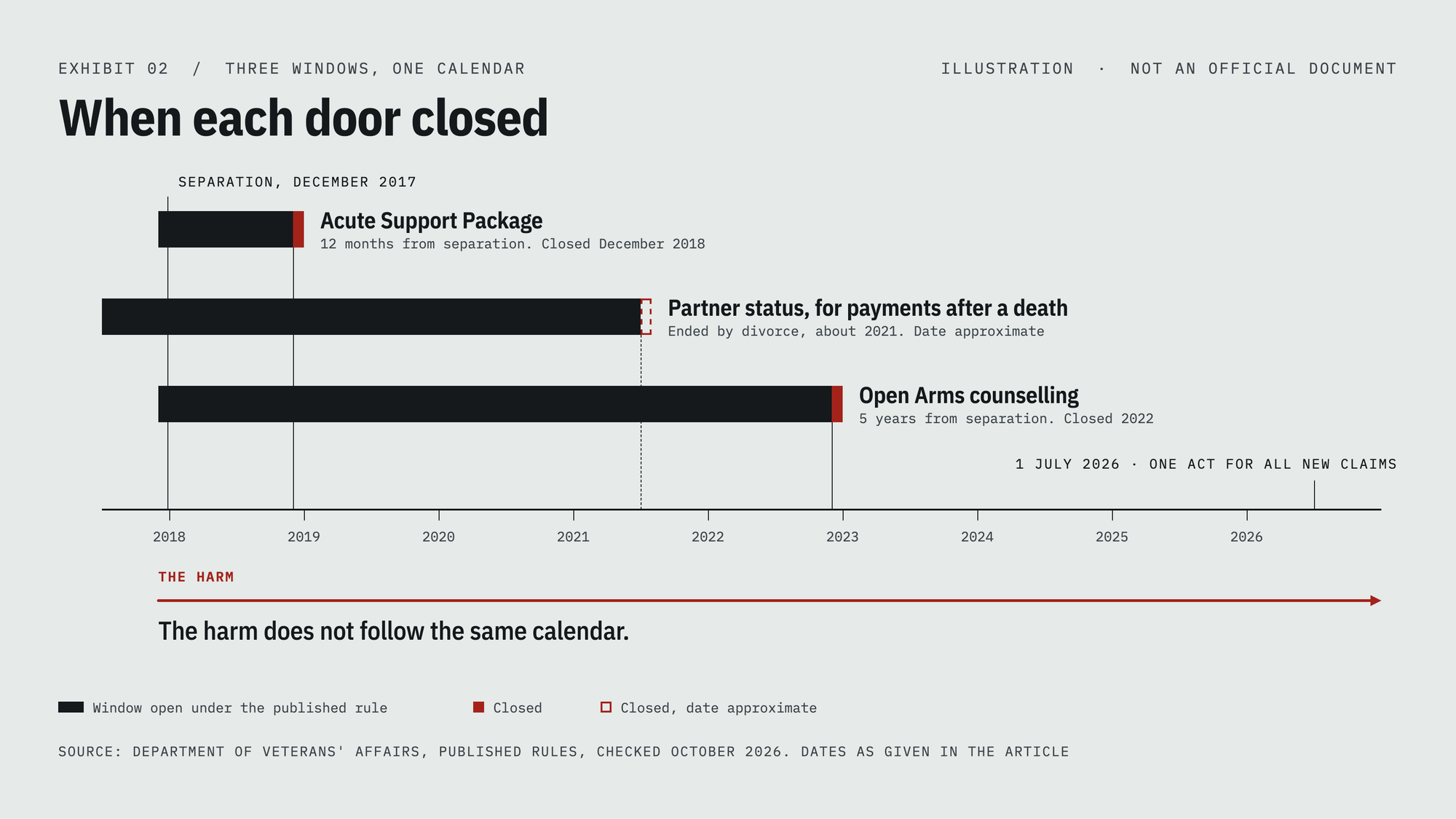
Third, the limits run from separation. Twelve months for one package, five years for counselling, then nothing. The harm does not follow the same calendar.
These supports are real, and they help many families. The gap is specific: a former partner harmed during the veteran’s service, while he is alive, has no way in on her own account.
What I am asking for
- A pathway in her own right. A former partner who experienced family violence during the member’s service should be able to apply for support directly, without depending on the veteran’s payments, his rehabilitation or his nomination.
- Time limits measured from need, not from separation.
- The question asked. No inquiry I have found has considered whether any compensation should reach family members harmed by a service-related injury during the veteran’s lifetime. It should at least be studied.
Conclusion
The system has an answer for the wife of a soldier who dies. It has very little for the woman who lived beside the injury, and nothing at all for her once the marriage is over.
The financial abuse at the end of the marriage left me with very few options and no support. I was mentally unwell. I still am, but it is manageable.
For twenty-one years I was an army wife, supporting my husband’s career. With that came the abuse, and a trauma that has never left me. Being separated from her children is the cruellest thing that can happen to a mother. And yet it happened to me. I was homeless, without resources or money.
How could this have happened? Institutions still have no answer to that question.
Compensation is not the answer for me now. What I am asking for is recognition: that all of this went unnoticed, and that I paid the ultimate price for being an army wife. The policies are built around looking after the soldier. Yet who comes out of this worst?
It is recognition that this happened, that it was unfair, and that it was a breach of my human rights. That is what my research is about.
No one can give back the time I lost with my children, and money will not heal the pain. Nothing will help now.
Institutional silence destroyed my life. It really is that simple.
This article describes published rules. It is not legal advice. For free legal help: Defence and Veterans Legal Service 1800 33 1800. Support: Open Arms 1800 011 046 · 1800RESPECT 1800 737 732. New Zealand: Women’s Refuge 0800 733 843 · 1737.
Sources
- Department of Veterans’ Affairs, Compensation for dependants (veterans’ legislation reform).
- DVA, Military Compensation (MRCA) Policy Manual, 7.5.1 Who can be a dependant and 7.8.2 Wholly dependent partner benefits.
- DVA, MRCA Policy Manual, 5.12.1 Additional compensation payments (section 80).
- DVA, Rehabilitation Policy Library, 6.5.3.1 Eligibility for the Family Support Package.
- DVA, Acute Support Package.
- Open Arms, Eligibility matrix.