Left Behind
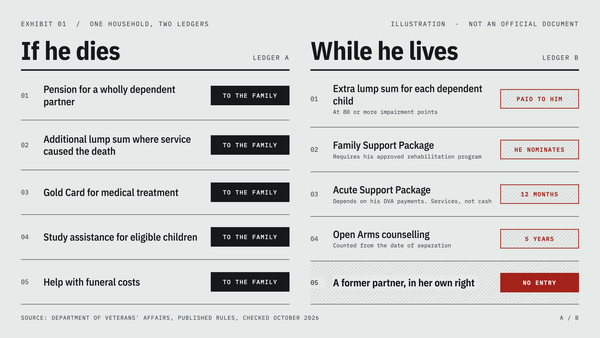
Up to 2,859 ADF personnel were given tafenoquine or mefloquine in Army Malaria Institute trials. Zero support programs exist for their spouses or children.
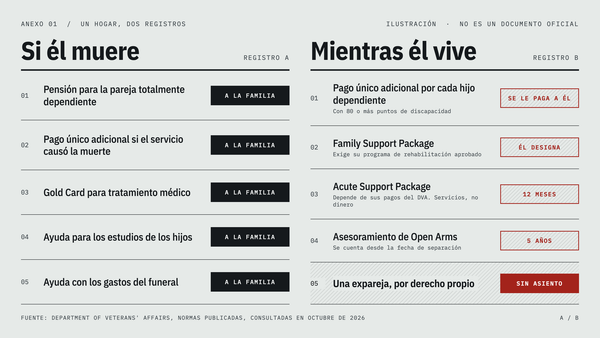
Versión en español: Los que quedaron atrás
POLICY NOTE — THE RECOGNITION GAP
2,859 QUINOLINE-EXPOSED · 0 FAMILY SUPPORT PROGRAMS · 25+ YEARS
I was an army wife. My former husband was deployed to East Timor, where he participated in the antimalarial drug trials this series documents. I lived with the consequences for years before I had the evidence or the framework to understand what had happened — to him, to me, and to our family. This series is the result of that understanding.
Between 1999 and 2002, 3,711 ADF personnel were enrolled in Army Malaria Institute clinical trials. Of those, up to 2,859 were given tafenoquine, mefloquine, or both. Zero formal support programs have been established for their spouses or children. These families have waited more than twenty-five years for acknowledgement. No policy category currently recognises them as secondary casualties of the trials their partners and parents participated in.
Those four numbers are the architecture of this article. Everything that follows is an attempt to explain how that architecture was built, why it has not been dismantled, and what it will take to change it.
What makes these families different
Every military family carries the weight of service. Deployment is hard. Reintegration is hard. The psychological consequences of operational service are real and serious and have their own long history of institutional neglect.
So what makes the families of ADF quinoline veterans different?
The answer is precise and it is not sentimental. These families are different because the harm they experienced was not an unavoidable consequence of military service. It was the direct and foreseeable consequence of a specific government decision — the decision to administer experimental neurotoxic drugs to their partners and parents, in the context of formal clinical drug trials, without adequate informed consent, at doses exceeding approved limits, and without any follow-up care when those deployments ended.
The neurological injuries documented throughout this series were produced by formal clinical trials conducted by the Army Malaria Institute. This is not PTSD from combat exposure — a harm that carries its own serious weight and its own serious institutional failures, but one that originates in the nature of operational service. This is pharmacological brain injury produced by an experiment the soldier was enrolled in, and that the family knew nothing about at all.
ADF trial subjects received mefloquine at loading doses of up to 1,500 mg per week — six times the approved prophylactic dose. Tafenoquine subjects received doses not approved anywhere in the world for civilian use. In 2009, WRAIR's own scientists established tafenoquine as the only antimalarial drug more neurotoxic than mefloquine. No longitudinal follow-up health studies were initiated for the 1,540 ADF tafenoquine trial subjects. None have been conducted to this day.
Because the ADF and DVA failed to recognise quinoline-induced brain injury as distinct from PTSD, wrong treatment meant the neurological substrate of dangerous domestic behaviour remained unaddressed — indefinitely. The families living with that behaviour had no recourse within any existing system, because no existing system had been designed to account for their situation.
The causal chain runs directly to the government. Government authorised the trials. The Army administered the drugs. The drugs damaged the brain. The damaged brain produced dangerous behaviour at home. The family bore the consequences. At no point in that chain did the family make a choice that placed them in harm's way.
The international picture
Australia was not alone in administering these drugs to military personnel. The United States, the United Kingdom, and Canada all used mefloquine extensively on deployments during the same period. All three countries have encountered the same downstream problems. None of them have reached a substantially different conclusion about the families.
In every country examined, the veterans' welfare system was built around the veteran as the subject of harm and the subject of entitlement. The family is conceived, in each of these systems, as a support resource for the veteran — not as a population that may itself have been harmed by military decisions.
The US FDA issued its black box warning on mefloquine in 2013. The European Medicines Agency found a signal of persistent neuropsychiatric and vestibular effects in 2014. The UK House of Commons Defence Committee recommended mefloquine as a drug of last resort in 2016. Canada's Armed Forces Surgeon General commissioned an independent task force that reported in 2017. Australia's Senate inquiry followed in 2018, and the Royal Commission in 2024.
In none of these jurisdictions has a formal support program been established for the spouses and children of affected veterans. In none of them has a compensation framework been created. In none of them have domestic violence outcomes in the quinoline veteran cohort been studied. The universal blind spot is not a coincidence. It is a structural feature of how every veterans' welfare system in the Western world was designed.
What these families lost
The women in these households lost things that the current system has no category to recognise or address.
They lost years — to a situation they could not name, to treatment that did not help, to legal proceedings that did not understand the neurological context of what they were assessing.
They lost children — through family court proceedings in which a father who presented as functional and remorseful was assessed without the neurological framework that would have made his risk comprehensible, and in which a mother who described behaviour that no clinical category could explain was assessed accordingly.
They lost financial security — having organised their lives around a military career, having sustained the costs of legal proceedings they could not afford, having emerged from those proceedings without the resources or the recognition to rebuild.
They lost the accurate account of what had happened to them. That loss is harder to quantify than the others, but it is not smaller. The stories people tell themselves about why their lives took the shape they did are not incidental to their health or their recovery. A woman who has spent twenty-five years believing that her former husband was fundamentally a certain kind of person, that she failed to protect her children from a man she chose, that the systems that failed her did so because her situation did not merit a different response — that woman is carrying a weight built on a false foundation. The accurate account does not undo what happened. But it changes what the harm means, and it changes what response it requires.
Why the gap has not been closed
The gap between what happened to these families and what has been done about it is not explained by ignorance. The Senate inquiry heard from affected families in 2018. The Royal Commission heard from them in private sessions between 2021 and 2024. The QVFA has documented the family harm in its advocacy submissions for years. The peer-reviewed literature on domestic violence in veteran populations is extensive, if not specific to the quinoline cohort.
The gap has persisted because closing it requires something that no institution has yet been willing to do — formally recognise spouses and children as secondary casualties of the drug trials, with the legal, financial, and policy consequences that recognition entails.
Recognition would require the government to acknowledge that the harm to families was foreseeable — because it was. It would require DVA to create an entitlements pathway for people who are not veterans — which would be a significant structural departure from everything the system was designed to do. It would require the family law system to develop a protocol for quinoline-related neurological risk assessment — which does not exist. It would require the domestic violence sector to develop a training framework for quinoline-specific presentation — which has never been commissioned.
None of these things are impossible. All of them have been called for, specifically and repeatedly, by advocates who have the evidence to support the call. What has been missing is the institutional will to act — and the public pressure that creates it.
What must happen
The Australian Government must formally recognise spouses, partners, and children of ADF quinoline trial veterans as secondary casualties — in policy, in law, and in public statement. This recognition must be unconditional. It must not be contingent on the veteran's DVA status, on the outcome of any claim, or on any individual assessment of causation.
A dedicated, independently administered support program must be established for affected families — covering psychological care, neurological assessment, financial support, legal assistance, and child-focused services. It must be designed with the people it serves, not for them, and it must be adequately funded to reach the full scope of the affected population.
The Veterans' Entitlements Act and the Military Rehabilitation and Compensation Act must be amended to create a pathway for family members harmed as a foreseeable consequence of ADF clinical drug trials.
Independent research must be commissioned urgently into domestic violence and child harm outcomes in the quinoline veteran cohort. That research must include the perspectives and testimony of affected partners and children. It must be survivor-led and participatory.
Every institution that encounters these families — domestic violence services, family courts, schools, GPs, mental health services — must receive guidance and training that enables them to recognise the quinoline context and respond appropriately.
A public, formal, and unconditional apology must be made to the spouses, partners, and children of ADF quinoline veterans — acknowledging what the government knew, when it knew it, what it chose not to do, and the consequences of that choice for families who deserved better.
These are not radical demands. They are the minimum response proportionate to the harm. The families documented in this series did not choose to be in harm's way. They did not consent to anything. They were not warned. They were not monitored. They were not supported when the consequences arrived. And they have been waiting — without acknowledgement, without recourse, and without rest — for more than twenty-five years.
The silence is not neutral. It is a decision, made repeatedly, year after year, to look away. The evidence that would justify a different decision has existed in the public record for decades. What has been missing is the institutional willingness to act on it — and the public visibility that creates the pressure for institutions to do so.
That is what this series is attempting to provide.
Key sources
- Senate Inquiry report and submissions, December 2018 — Parliament of Australia.
- Royal Commission into Defence and Veteran Suicide, Final Report, Volume 4, Chapter 22, September 2024.
- McCarthy S. Senate Submission 94, 2018.
- Quinn JC. Evidence lodged with Senate Submission 16 (Australian Quinoline Veterans and Families Association), 2018.
- US FDA Drug Safety Communication on mefloquine, July 2013.
- European Medicines Agency PRAC Assessment Report EMA/63963/2014. Not published online by the EMA; cited in Nevin RL (2017), Pharmacology Research & Perspectives.
- Finlayson-Short L, et al. Intimate Partner Violence among current and ex-serving Australian Defence Force personnel and families. Phoenix Australia – Centre for Post-traumatic Mental Health, commissioned by the Department of Veterans' Affairs (2015 data).
- Felitti VJ, et al. Relationship of childhood abuse and household dysfunction to many of the leading causes of death in adults. American Journal of Preventive Medicine, 1998.
Related reading
- Previous in the series: Just the Army Wife
- Next in the series: She Was Left With Nothing
- I Was Never Asked: The Spouses Missing from the East Timor Family Study
Part of Unacknowledged Casualties. Read the full series at /unacknowledged-casualties/
Note on the figures
The trial numbers in this series come from the Department of Defence's own record of the Army Malaria Institute studies, as reproduced in the 2018 Senate inquiry report.
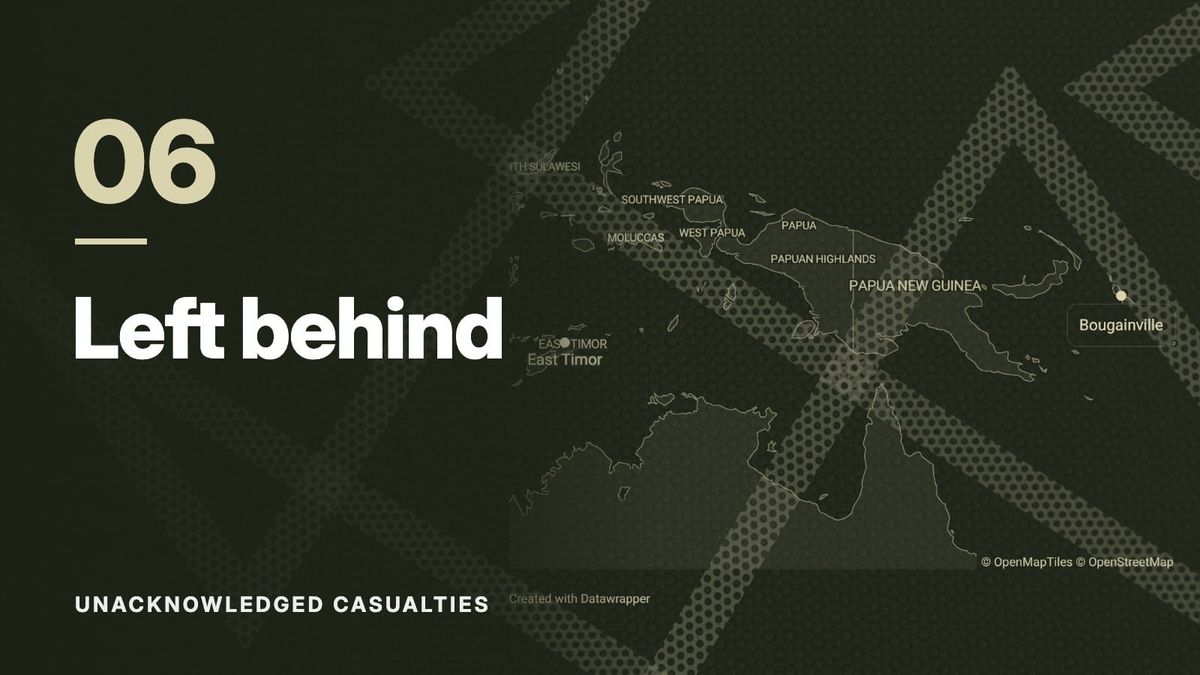
- Tafenoquine: 1,540 personnel. 1,017 in the 1999–2000 eradication study (Bougainville and Timor-Leste), 492 in the 2000–01 prevention study (Timor-Leste), and 31 in a 2000–01 treatment study in Australia.
- Mefloquine in the trials: 1,319 personnel. 1,157 in the 2001–02 prevention study (Timor-Leste), and 162 in the comparator group of the 2000–01 tafenoquine prevention study.
- Tafenoquine or mefloquine in the trials: up to 2,859 personnel (1,540 + 1,319), described in this series as "nearly 3,000". Some people may have taken part in more than one study.
- All trial participants: 3,711, including the comparator groups given primaquine (464) or doxycycline (388).
- 3,523 is a wider figure. The Senate committee's maximum combines everyone who took either drug in the studies with mefloquine prescribed to ADF members outside the studies since 2001. The committee noted it is "likely" an overestimate because the groups may overlap.
Sources
- Senate Foreign Affairs, Defence and Trade References Committee, Use of the Quinoline anti-malarial drugs Mefloquine and Tafenoquine in the Australian Defence Force, Chapter 3, December 2018 — paragraphs 3.28–3.29 and Table 1.
- Department of Defence, Antimalarial medications — trial participant numbers by study.