One Tablet
He was young and excited, only four years into the military and heading into his first deployment. On 20 September 1999 he came ashore with Operation Stabilise, leaving Lavarack Barracks that morning as part of 2 RAR, pushing west to establish a base at Balibo.


Versión en español: Una tableta
Author’s note
This account reconstructs the experience of one soldier on the first INTERFET rotation to East Timor in 1999. It draws on the published record — the Senate committee's examination of the ADF anti-malarial trials, the deployment histories, the pharmacology — and on first-hand testimony from inside the household that soldier returned to. It is not a composite and it is not fiction.
It is conditional, and the conditionals are the point. Where this account says if he was switched from doxycycline to mefloquine, the if is real and remains unresolved. No record exists that would settle it; the trial register cannot say with certainty who was in which arm. What would follow from that switch is set out here as mechanism, not as finding.
The author did not serve and does not claim to have. What she can attest to is the return, and the twenty-five years after it.
Details that would identify third parties have been withheld or altered.
1999. One tablet. One day.
A small act that ordered all the others.
He was young, excited, barely four years into the military and already stepping into his first deployment. He came ashore on 20 September 1999, the D‑Day of Operation Stabilise. That morning he had left Lavarack Barracks in Townsville, one soldier among the 2nd Battalion, Royal Australian Regiment. Activated for peacemaking three days earlier, the battalion pushed west into the border country and established its base at Balibo.
One fact orders all the others.
He served on the first rotation — INTERFET, 1999 — not the UNTAET rotation that followed in 2000. That distinction fixed the ground he walked, the drugs he was given, and the conditions he lived under. The men who arrived after him met a materially different war.
The Doxycycline vs. Mefloquine Reality
The Daily Tablet
On the 1999 rotation the mandatory anti‑malarial was doxycycline. The tafenoquine trials came later, with 1 RAR in late 2000; they had not yet begun. First‑rotation soldiers took one tablet a day, every day — no exceptions, no reprieve.
The cost showed at once. In the East Timor heat the drug turned sunlight into a hazard: skin blistering and rashing after brief exposure, stomachs answering with nausea, cramps, and vomiting. Compliance frayed under both. Men made ill by the medication, and made raw by the sun, quietly let it lapse.
Malaria filled the space they left. Close to seventy soldiers on the rotation contracted the disease. The scale of that failure forced the ADF to reconsider how it protected the rotations still to come.
A Second Drug
Doxycycline was the standard, but the men who could not tolerate it were moved to mefloquine, sold as Lariam. If he was among them, he was exposed to a different order of harm: acute anxiety, vivid nightmares, depression, sharp paranoia. The reactions were well documented, and in time drew significant controversy.
The Washout
Home again in Townsville around January or February 2000, every first‑rotation soldier underwent a mandatory fourteen‑day course of primaquine to clear the parasites still in the body. Primaquine brought its own abdominal pain and nausea, and in men with G6PD deficiency, acute hemolytic anemia. After months in the field, even the ending exacted a physical toll.
The Ground at Balibo
Balibo was among the most ruined and volatile places of the deployment. Pro‑Indonesian militia had destroyed the town, and 2 RAR held it under the constant threat of cross‑border raids, with firefights breaking out in the sectors nearby. To secure it was to live amid the aftermath of that violence — readiness held at a permanent high, sleep broken night after night. This strain did not stand apart from the drugs. It bore down on their effects and sharpened them.
Two Mechanisms
For many 1999 veterans, the neurological and psychological damage did not hold steady. It deepened across the years. His later condition, plausibly, was two injuries braided together: severe, chronic Post‑Traumatic Stress Disorder and — if he was switched to mefloquine — the neurotoxic residue of the drug. Distinct mechanisms, overlapping in effect, account for how such a decline unfolds over a life.
The first is trauma. The hyper‑vigilance the border demanded does not leave the brain as it found it; it reshapes physical structure, the amygdala and hippocampus among the regions rewired by unrelenting threat. PTSD does not stay fixed. Left untreated, or buried beneath coping, the steady discharge of cortisol and adrenaline wears the nervous system down, and across years or decades emotional regulation erodes, memory falters, reactivity climbs. There is a pattern to its concealment: many veterans hold steady inside work, family, and constant motion, then age, retire, or slow, and the mechanisms that once contained the symptoms give way. The trauma returns with more force than before, often wearing the face of a sudden collapse.
The second is chemical. Acquired brain injury is damage done to the brain after birth by something outside it — here, a drug. If he was switched from doxycycline to mefloquine because his stomach or his skin gave out, he received a compound now recognised as neurotoxic. Mefloquine crosses the blood–brain barrier and can injure the central nervous system for good, striking the brainstem and the limbic structures that govern fear, balance, memory, and emotion. Its toxicity imitates PTSD, or magnifies it: progressive memory loss, severe cognitive decline, chronic executive dysfunction, deep depression, unprovoked rage, vestibular disturbance, central nervous system abnormalities that worsen with age. Often the symptoms surface years after the last dose and are read as purely psychological.
Why the Switch Was Likely
Balibo ran on discipline, and that is where the story of the switch begins. Set near the West Timor border and treated as a warlike sector, it was 2 RAR’s task to hold against militia incursion, and the dense jungle around it was ideal ground for malaria‑carrying mosquitoes. To keep the men combat‑ready, command enforced strict daily pill parades — each soldier swallowing his tablet in front of an officer or a medic, compliance non‑negotiable. Dili offered the counter‑case: a sprawling, chaotic hub of thousands of troops and many nations, where daily supervision was far harder and discipline ran uneven.
Discipline could not solve the underlying problem. In the border heat doxycycline made men vomit and burn, and a soldier who brought his pill back up was left with no protection at all — an unacceptable exposure in a high‑threat sector. So the medics moved the sick and the non‑compliant onto weekly mefloquine. The change ended the daily nausea and, in the same motion, introduced a potent neurotoxin into an environment already saturated with stress.
The malaria came regardless. Balibo and the border areas near it, Batugade among them, became the epicentre of infection for the rotation, and 2 RAR was hit hard — evidence that doxycycline was failing in the field. That failure fed directly into the Army Malaria Institute’s decision to trial alternatives, tafenoquine among them, on later rotations.
The Weight of the Rank
He carried more than his own dose. As a Lance Corporal — a junior non‑commissioned officer, the hinge between the officers above and the privates below — the whole regime pressed on him twice.
He had to enforce it. He stood at the pill parades and watched his section swallow their doxycycline under supervision, and any lapse in that discipline — a man skipping his tablet, then catching malaria — would have reflected on him. Nor could he spare himself. The rank demanded the example, so he took his own tablet in front of them, day after day, even as it made him violently ill.
Because he enforced compliance, he also reported it. Any severe reaction, his own or his soldiers’, went to the Regimental Aid Post, and in Balibo the medical answer was consistent. Persistent vomiting, incapacitating cramps, food that would not stay down, photosensitivity blistering into open burns — the medical officer’s routine response was weekly mefloquine, protection without the daily gastrointestinal wreckage. Which is precisely why a Lance Corporal in Balibo stood at high risk of the switch.
The load ran deeper than medication. Lance Corporals held a double weight — the full tactical danger of a frontline soldier and the accountability of a leader answerable for his section’s welfare and discipline. Even inside the Balibo Fort it meant unbroken vigilance, responsibility for communications or operations, constant exposure to threat, and the strain of leading men in a warlike place. Leadership pressure, lost sleep, and the possible neurotoxin together laid a severe foundation for what came after.
Twenty Kilograms
Losing twenty kilograms in three months is an extraordinary and dangerous decline in an active‑duty soldier. At Balibo it came from three pressures wound tightly together.
The first was the doxycycline trap. Fixed inside the fort under rigidly enforced compliance, a soldier whose stomach could not take the drug — as many could not — lived with chronic nausea, daily vomiting, severe cramps, and an appetite that simply vanished. Heavy combat ration packs grew nearly impossible to digest. Many base‑bound men stopped eating altogether, their bodies unwilling to hold food while the drug inflamed them from within.
The second was the environment. Balibo in late 1999 was primitive: hard heat, dust, an endless press of flies and mosquitoes, thin sanitation, no fresh food. Even without patrols, dehydration was constant. Set against the vomiting and the poor intake, the body burned through fat and then muscle.
The third was the static stress of command. The headquarters roles were a pressure cooker — endless shift rotations, two to four hours of broken sleep, the ever‑present threat of attack, an operational tempo that never eased. Chronic stress floods the system with adrenaline and cortisol, driving the metabolism faster while shutting digestion down, and the weight falls away.
Twenty kilograms in ninety days is a body in survival mode. Starvation, dehydration, sleeplessness, prolonged stress — research is clear that each strips the brain of its resilience, and here they arrived at once. To endure that collapse while carrying the psychological weight of junior leadership in a warlike zone was to lay, unknowingly, the ground for a deterioration that would surface across the decades.
The Two Drugs Are Not the Same
The distinction matters, because the consequences diverge. Doxycycline is vicious in the short term — nausea, vomiting, lost appetite, burning skin — but it does not cross into the brain, and it leaves no lasting neuropsychiatric wound. Mefloquine does. It is associated with neurotoxic effects in some patients, capable of brainstem injury, limbic disruption, progressive cognitive decline, rage, depression, vestibular dysfunction — symptoms that can deepen over decades.
Given a severe long‑term decline, two drivers stand out. The first is delayed‑onset PTSD, born of Balibo’s stress and the burden of the rank. The second, conditional on the switch having occurred, is an undocumented mefloquine exposure, prompted by the compliance environment that would not let him refuse and the intolerance that pushed the medics to act. For three months his brain went malnourished, dehydrated, and starved of sleep while processing the unbroken stress of a warlike place — the recognised catalyst for severe, chronic, progressive PTSD and long‑term cognitive change.
If He Worked in Operations
One role would have concentrated all of this to a point. If he worked in Operations inside the 2 RAR Battalion Headquarters at Balibo Fort, he sat at the psychological centre of the deployment. The absence of foot patrols would not have shielded him. It would have exposed him instead to a distilled form of the same stress — enough to account for both the vanished weight and the long decline.
The Ops room was where the battalion’s information converged. Every radio report, intelligence update, casualty notice, and contact report from the border patrols passed through it. He would have logged the traffic from men actively fighting the militia, or being hunted by them — hearing the panic, the firefights, the crises as they happened, unable to reach out and protect his mates. Ops staff track every friendly unit and every threat on the map, and so he knew, at all hours, exactly how close the militia stood to the wire. Under that knowledge the amygdala does not rest; it stays lit, and the adrenaline keeps coming.
The room never closed. In a critical border deployment the Ops room runs around the clock, seven days a week, and a junior NCO works its brutal, erratic rotations. Months of broken two‑hour sleep destroy metabolic regulation and cognitive stability alike. Under constant threat and starved of rest, the brain burns calories at an extreme rate on stress and anxiety alone; set beside the nausea, the vomiting, and the food that would not stay down, that burnout becomes a principal engine of dangerous weight loss.
Inside headquarters there was no evading the dose. Under the direct daily eye of senior officers and medics, he could not skip it, and when the gastrointestinal effects struck he worked through twelve‑ to eighteen‑hour shifts while physically sick, his body blocked from drawing nutrients out of the ration packs it already struggled to hold. The weight fell faster still.
Chronic sleeplessness, severe gastrointestinal distress, extreme weight loss, unbroken adrenaline, leadership pressure, and — if the switch came — mefloquine’s neurotoxicity: these are the factors this reconstruction sets down at Balibo. Together they describe a body and a brain held for three months at the edge of what either could sustain.
Does One Month Versus Two Matter?
For mefloquine, duration matters — but not in the way most assume. The drug can inflict permanent neurological injury after a single dose. It is highly lipophilic; it crosses into the brain; it gathers in the brainstem and limbic system; and its half‑life runs as long as thirty days. Once it enters the central nervous system, the injury can continue even after the drug itself has cleared.
Longer exposure raises the severity of the injury rather than its kind.
A dose or two carries the possibility of permanent harm.
Several weeks of weekly dosing allow the concentration to climb and the accumulation to deepen.
Past roughly two months, the risk of chronic, progressive symptoms rises further.
Duration shapes severity; it does not alter the mechanism.
Even brief exposure can leave a lasting wound.
This is a general principle of pharmacology, not a diagnosis, and it rests on how the drug moves through the body. Mefloquine clears slowly. A single dose can persist for weeks; weekly dosing lifts the burden gradually. By about a month, the level has risen above where it began — enough, in some people, to reach the brain and do lasting work. A second month raises the total again, and because the drug concentrates in fatty tissue, the brain can hold more of it than the blood.
More time on it generally means more of it left behind.
After Townsville
The exposure did not end cleanly at the border. ADF protocols required soldiers to keep taking their anti‑malarial for a period after coming home, because malaria can lie dormant; the weekly dosing continued for several weeks past arrival, alongside the separate fourteen‑day primaquine course meant to clear the liver‑stage parasites. And even after the last dose, the drug lingered in the body for weeks, its neurological effects outlasting its clearance.
The return felt like safety, but the biology did not reset. The body was still carrying the chemical burden of deployment; the nervous system was still shaped by months of strain; the brain was still adapting to an injury no one had named. Home changed the surroundings, not the state of the system.
What the Return Did Not Undo
Home changed how recovery felt without reversing what had already happened. A better diet cannot flush mefloquine from a brain it has already entered; that injury is chemical and structural, not metabolic. Better sleep cannot reverse what sleeplessness carved — the shrunken hippocampus, the impaired prefrontal cortex, the long dysregulation of emotion — because those changes are structural too. A safer place lowers the stress without repairing the damage; the nervous system may steady for a while as the underlying injury holds, which is why symptoms so often worsen with age.
The transition carried its own effects. The abrupt move from a warlike world to a peaceful one leaves the brain’s inner alarm mismatched against an outer calm — a pattern observed across many veterans. Deep sleep after long deprivation can drive dreams and nightmares harder as the mind catches up. When the outer danger vanishes but the inner alarm keeps sounding, anxiety, irritability, and hypervigilance grow more noticeable rather than less. Ordinary food after months of rations unsettles digestion and energy without touching the neurological ledger.
Switching While Already Broken
The most consequential interaction is the timing of the switch. If he was moved to mefloquine while already malnourished, sleep‑deprived, and twenty kilograms lighter, the factors would have converged.
Severe starvation and sleeplessness degrade the blood–brain barrier, the membrane that normally guards the brain from toxins. A compromised barrier lets more of the drug reach the brainstem and limbic system, where mefloquine’s neurotoxic effects are concentrated. The drug is meant to be taken with a heavy, fatty meal; on ration packs its absorption would have been erratic and harsh, its toxicity heightened. And after three months of sleeplessness, malnutrition, dehydration, adrenaline overload, and command pressure, almost nothing remained in reserve to absorb the arrival of a neurotoxin.
On this reading, it is the timing — not the dose, not the duration — that makes the hypothesised trajectory progressive rather than self‑limiting. Longer exposure would have deepened the harm; even short exposure could have caused permanent injury; but the switch, if it happened, came at the moment the body and brain were least able to bear it.
The Trajectory
The shape of the decline is familiar. A slow worsening across years, punctuated by explosive episodes, ending in a sharp collapse around medical discharge — this tracks the general pattern of long‑term trauma and stress‑related conditions.
Around mid‑life, the brain’s capacity to compensate for old injury or stress can ebb, and symptoms once managed grow harder to hold. When the regulatory systems are already strained, a sudden surge of stress or feeling can overrun them — a recognised feature of several long‑term psychological conditions. And leaving the military strips away structure, identity, routine, and the company of peers all at once; that departure is widely understood as a high‑risk window, a time when symptoms tend to worsen.
The factual claim beneath this stays narrow. Longer exposure generally leaves more mefloquine in the body; even short exposure can have lasting effects; returning home does not reverse neurological changes; sudden shifts in sleep, diet, and surroundings can make symptoms more noticeable; and slow worsening across years is a recognised pattern in long‑term trauma‑related conditions. These are general principles, not conclusions about any one man.
The Household
The deployment worked on a single nervous system. It did not stop there.
When trauma‑related symptoms persist inside a home over years, a second nervous system — the spouse’s — adapts to them. That adaptation carries names of its own. The household is not a separate subject but the same one continued: the long decline observed from inside the house.
Secondary Traumatic Stress is the established term for the strain that grows in a partner living in prolonged closeness to someone carrying trauma‑related symptoms — the chronic vigilance, the exhaustion, the fear of a reaction that cannot be predicted, the broken sleep, the anxiety, the state of walking on eggshells. It is not a weakness in the spouse but a normal nervous system responding to long exposure to another’s distress. Human nervous systems co‑regulate; when one person lives permanently in a threat state, the other’s body adapts to survive alongside it.
Vicarious trauma is the slower absorption of the veteran’s experience over time, surfacing as emotional numbing, avoidance, intrusive thoughts, chronic fear, an inability to rest, and a sense of being responsible for keeping the peace. The pattern is documented in the partners of first responders, military personnel, and others living beside severe stress injuries.
The eggshell walk itself has a clinical name: hyper‑vigilance by proxy — the constant reading of tone, mood, and micro‑expression; the anticipation of a sudden turn; the small adjustments made to head off escalation; the life lived in unbroken alertness. It is not a change of personality but a survival adaptation.
The Structural Failure
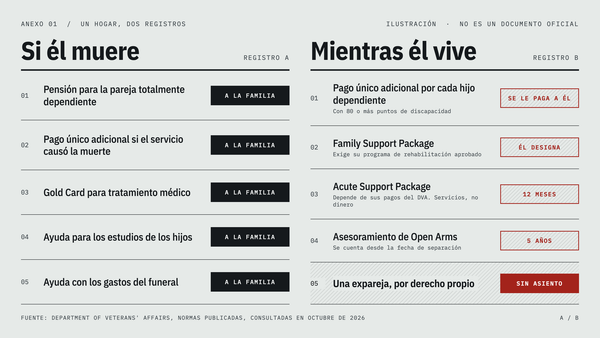
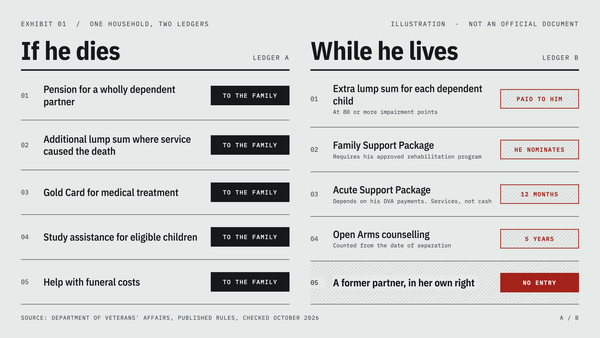
The failure to prepare these families was systemic, not personal. Trauma research has words for it — institutional blindness, institutional abandonment — the situations where families are told nothing of the behavioural changes that may come; where spouses are never taught to recognise a stress injury; where no support exists for early warning signs; where the whole weight of managing symptoms falls on the household alone. In the late 1990s and early 2000s, this was ordinary. Families were expected to cope without tools.
Two further terms mark the long cost. Caregiver stress is the chronic strain of supporting someone whose behaviour is unpredictable and volatile. Ambiguous loss is the grief of losing the person you knew — psychologically gone while still physically present — a grief made harder by having no clear endpoint and no social recognition.
When the Injury Was Named
For years, veterans who showed behavioural or cognitive symptoms were diagnosed only with PTSD. The possibility of a drug‑related neurological injury was neither widely discussed nor understood. Recognition came slowly — through research, advocacy, the testimony of veterans, and institutional review — and it was not part of the diagnostic frameworks of the early 2000s. Families were not told, not prepared, not supported.
They lived inside a situation no one explained to them, prepared them for, or carried them through. The impact on them is real, recognised, and documented — and, historically, unacknowledged. The gaps only compounded it: understanding of these long‑term conditions evolved slowly; what reached families was inconsistent; those posted overseas were often missed entirely; support for ex‑partners was never systematically communicated; and many households received no guidance and no early warning at all.
That gap is now widely acknowledged in the research on veteran families — the last, quiet extension of a decline that began on a border, with a tablet, on 20 September 1999.