If This Is Your Story
For partners, former partners, and adult children of ADF quinoline veterans who recognise their own experience. You did not imagine it. It was not your fault.
Versión en español: Si esta es su historia
WRITTEN FOR THE PEOPLE THIS SERIES IS ABOUT
PARTNERS · FORMER PARTNERS · ADULT CHILDREN · VETERANS
I was an army wife. My former husband was deployed to East Timor, where he participated in the antimalarial drug trials this series documents. I lived with the consequences for years before I had the evidence or the framework to understand what had happened — to him, to me, and to our family. This series is the result of that understanding.
If you are in immediate danger, call 000. Lifeline 13 11 14 · 1800RESPECT 1800 737 732 · Open Arms 1800 011 046 — all available 24 hours.
This article is the one I have thought about longest — because it is not addressed to a general audience, or to professionals, or to institutions. It is addressed to the people this series is fundamentally about.
If you are a partner or former partner of an ADF veteran who served in East Timor or Bougainville, and something in these pages has named an experience you have been carrying without a name — this article is for you.
If you are an adult child who grew up in a household shaped by a parent's behaviour that was never explained, never acknowledged, and never connected to anything you were told about — this article is for you.
If you are a veteran who took these drugs and has spent years trying to understand what happened to you and to the people you love — this article is for you too.
This article does not offer medical or legal advice. What it offers is an acknowledgement — without qualification, without hedging, and without the institutional caution that has surrounded this subject for twenty-five years — that what happened to you has a documented context, that you are not alone in it, and that it was not your fault.
If you are a partner or former partner
If the person you loved came back from deployment changed — in ways that frightened you, confused you, and that no one around you could explain — you did not imagine it.
The personality changes, the rage, the paranoia, the person who seemed to disappear behind someone else's eyes: these are documented effects of drugs administered to ADF personnel during the East Timor and Bougainville deployments. They are listed in the product information for mefloquine. They are described in forensic psychiatric literature. They are documented in Senate inquiry submissions. They were acknowledged by the Royal Commission into Defence and Veteran Suicide in its 2024 final report. They have happened to other families. You were not told this at the time. No one warned you. No institution monitored what happened in your household as a result. No system was built to help you when it did.
That is an institutional failure. It is not your failure. And it is not your partner's character.
What I want you to know
Living with someone whose brain has been neurologically altered by a drug is not the same as living with an abusive partner in the ordinary sense of that phrase — though the harm may have been equally serious, and sometimes more so.
The person who frightened you, hurt you, or controlled you may also have been a person who loved you, who was distressed by his own behaviour, and who had no more understanding than you did of what was happening to him. Both things can be true simultaneously. This series has held both throughout — because the accurate account of what happened in these households requires both.
None of this means the harm you experienced was acceptable. None of this means you should have stayed, or that leaving was a betrayal, or that the consequences for you and your children were anything other than real and serious and lasting. It means the origin of the harm was institutional — and the institutions responsible have not yet been held accountable for it.
You were not the cause. You were the consequence. And the difference between those two things matters enormously — not because it changes what happened, but because it changes what the harm means, who is responsible for it, and what a proportionate response to it looks like.
What you are still carrying that does not belong to you
Many of the partners and former partners this series documents have spent years carrying weight that was never theirs to carry.
The weight of an explanation that was wrong. The account that he was fundamentally a certain kind of person — narcissistic, abusive, choosing the behaviour — was the account available to you because the accurate account was never provided. That account was built on a missing piece. The missing piece is what this series has tried to supply.
The weight of a failure that was not yours. The relationships that broke, the legal proceedings that went wrong, the children who were caught in the middle — none of these outcomes were the inevitable result of your choices. They were the foreseeable result of institutional decisions that placed a neurologically injured man in a household without diagnosis, without treatment, and without any support for the people living with the consequences.
The weight of a grief that has no socially recognised form. The loss of a person who is still alive but changed. The loss of the marriage you thought you were in. The loss of children to legal proceedings that did not understand the context. These are real losses. The absence of a socially legible category for them does not make them smaller.
None of this weight belongs to you. It belongs to the institutions that created the conditions for it and have not yet been held to account.
If you are an adult child
If you grew up in a household shaped by a parent's quinoline-related neurological injury, I want to speak to you directly.
You may be reading this as an adult, looking back at a childhood that was confusing or frightening and that you have perhaps never been able to fully make sense of. You may have spent years constructing explanations for what you experienced — explanations that placed the cause somewhere in the family, somewhere in yourself, somewhere in a dynamic that felt personal because it was lived in a deeply personal space.
The explanation was always incomplete, because the most important piece of it was missing. What happened in your home had a cause outside your home. That cause has a name. It has a regulatory history. It has a chain of institutional responsibility. And none of it leads back to you.
The behaviour that frightened you was not about you. The rage, the paranoia, the emotional withdrawal, the episodes of harm that no one could explain — these were the manifestations of a neurological injury sustained by your parent from drugs administered by the Australian government. Not a revelation of character. Not a response to anything you did or failed to do. An injury. With a cause. And a responsible institution.
You were not the reason. You were the consequence. And you deserved to know this — not now, years later — but at the time, from the people and institutions that had the information and chose not to share it.
The childhood you had was shaped by something real. The confusion you felt was reasonable. The fear was a reasonable response to a genuinely frightening environment. The work of making sense of it — the therapy, the relationships, the long process of understanding what happened and what it cost — that work was necessary and it was real. And the fact that you have had to do it without an accurate account of what you were making sense of is one of the most concrete harms in this entire story.
What does not yet exist — and what this series is asking for
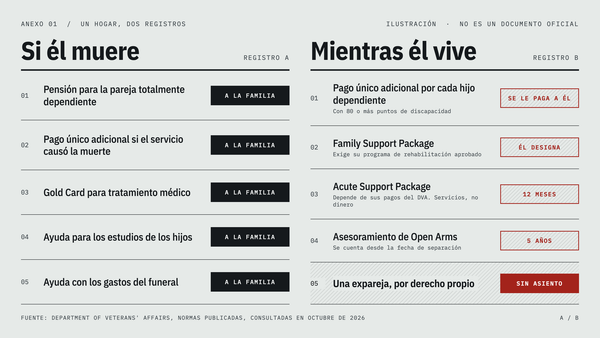
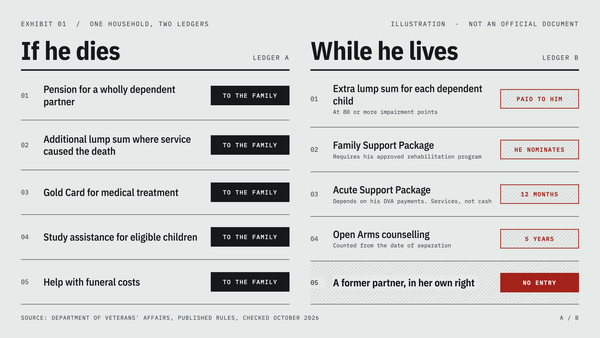
There is currently no dedicated government support program for partners, spouses, or children of ADF quinoline veterans. What does exist is limited but real.
Open Arms — 1800 011 046 — provides free counselling for family members of veterans. You do not need to be a veteran to call. Partners, former partners, and children of veterans can all access this service.
Legal Aid in your state or territory may assist with family law matters. The Defence and Veterans Legal Service — 1800 33 1800 — provides free legal support for veterans and families, including family law matters.
DVA's Acute Support Package provides some emergency financial assistance for veteran families in crisis.
What does not exist is what should. Formal government recognition of partners and children as secondary casualties. A dedicated, independently administered support program covering psychological care calibrated to this specific population, financial support, legal representation informed by the quinoline neurological context, and child-focused services. Legislative amendment to create a DVA pathway for family members of clinical trial subjects. Independent research into what happened to these families. A public apology.
These are not aspirational demands. They are the minimum response proportionate to the harm. And they have not been provided.
What this series has tried to do
This series began with the question I spent years unable to answer — not what happened in the most basic factual sense, but why, and who was responsible, and what an accurate account of it would look like.
The research that produced these articles is the result of that question. It is based on peer-reviewed science, regulatory agency documentation, Senate inquiry submissions, Royal Commission findings, and the advocacy record of people who have been making this argument, with this evidence, for more than twenty-five years. It is not the first account of this history. It is an attempt to make that history visible to a wider audience — and to connect it, explicitly and without softening, to the domestic and family consequences that have remained outside the frame of every official response.
The families documented in this series did not deploy. They did not take the drugs. They did not consent to anything. They were not warned, not monitored, and not supported when the consequences arrived. They have been waiting — without acknowledgement, without recourse, and without rest — for more than a quarter of a century.
This series exists because that wait has gone on long enough.
If your experience is reflected here — in part, in full, or in ways you have never been able to name before — I want you to know that what happened to you is documented, it matters, and it has not been forgotten. You have been carrying this long enough. You were never supposed to carry it alone.
Support
If you need support right now, the following services are available.
- Lifeline Australia: 13 11 14 — 24 hours, 7 days, crisis support and suicide prevention.
- 1800RESPECT: 1800 737 732 — 24 hours, national domestic and family violence counselling.
- Beyond Blue: 1300 22 4636 — 24 hours, support for depression, anxiety, and mental health.
- Open Arms: 1800 011 046 — 24 hours, veterans and families counselling. Available to family members of veterans. You do not need to be a veteran to call.
- Kids Helpline: 1800 55 1800 — free and confidential counselling for children and young people aged 5 to 25. Available 24 hours.
- Defence and Veterans Legal Service: 1800 33 1800 — free legal support for veterans and families, including family law matters.
- Safe Steps (Victoria): 1800 015 188 — family violence response, 24 hours.
- DV Connect (Queensland): 1800 811 811 — domestic violence helpline, 24 hours.
Jacqualine Roche is a writer and lived-experience researcher. She was an army wife. Her former husband was deployed to East Timor, where he participated in the antimalarial drug trials documented in this series. This is an independent public-interest research series. It does not provide legal or medical advice.
Related reading
- Previous in the series: What You Can Do
- Companion document: The Spouse: A Clinical and Social Profile
- It Is Never Too Late to Come Forward
Part of Unacknowledged Casualties. Read the full series at /unacknowledged-casualties/