Just the Army Wife
A first-person account of living inside the unrecognised consequences of government-administered neurotoxic drugs — and what it means to finally understand where responsibility sits.
Versión en español: Solo la esposa del soldado
FIRST-PERSON ACCOUNT — ADF QUINOLINE TRIALS
EAST TIMOR · 1999–2002 · THE HOUSEHOLD HE RETURNED TO
I was an army wife. My former husband was deployed to East Timor, where he participated in the antimalarial drug trials this series documents. I lived with the consequences for years before I had the evidence or the framework to understand what had happened — to him, to me, and to our family. This series is the result of that understanding.
This article discusses domestic violence and its long-term consequences. If you are currently unsafe: 000 for emergencies · 1800RESPECT 1800 737 732 · Lifeline 13 11 14
I was just the army wife.
That phrase contains an entire social position. The army wife exists in a clearly delineated role within military culture — supportive, adaptable, secondary. She moves when the army moves. She manages the household when her partner deploys. She absorbs, without complaint and without institutional recognition, the consequences of what deployment does to the person she married.
When that person comes home carrying a neurological injury produced by government-administered drugs, the army wife continues to absorb the consequences. There is no briefing for what the drugs might do. There is no outreach when the behaviour changes. There is no framework for what she is now living with. She is, in the fullest sense of the phrase, on her own.
This is my account of what that looked like. It is also an account of what I eventually came to understand — about him, about the institution responsible, and about the distance between those two things and the story I had been telling myself for years.
What I was told, and what I believed
When the behaviour changed, I did what most people in my position did. I looked for an explanation using the frameworks available to me. The military gave me one: deployment is hard, reintegration takes time, he has been through things you cannot understand. The clinical system gave me another: PTSD, trauma, the psychological weight of operational service. The domestic violence sector, when I eventually reached it, gave me a third: coercive control, a pattern of behaviour designed to dominate, a perpetrator who knew what he was doing.
Each of these frameworks contained some truth. Each of them was also, in its most important claim, incomplete.
What none of them told me was that my former husband had been administered an experimental neurotoxic drug during a government clinical trial — at doses exceeding the approved limit — without adequate informed consent, without monitoring of the neuropsychiatric consequences, and without any follow-up care when the deployment ended. What none of them told me was that the behaviour I was living with had a documented neurological cause, a name in the peer-reviewed literature, and a chain of institutional responsibility that ran directly to the Australian Government and the Australian Defence Force.
I was not told this at the time. I had no way of finding out independently. The institutions that knew it had chosen not to disclose it. And so I built my understanding of what had happened to my family on a foundation that was missing its most important piece.
What the label erased
To be just the army wife is to have your identity, your experience, and your suffering subsumed into a role that was never designed to make room for harm of this kind.
The labels available to describe what happened to me — and what I became — did not fit the reality I was living.
I was the army wife, which meant I was defined by my relationship to the institution rather than by my own claim to safety or recognition.
I was a domestic violence victim, which placed me in a category that did not account for the neurological origin of the harm and carried no pathway to the institutions actually responsible for it.
I was a carer, which described the role I occupied without naming the injury I was managing or the cost of managing it.
What I actually was — what no existing label captured — was a secondary casualty of a government drug trial. A person whose life had been shaped by an institutional decision she never knew had been made. A person whose harm has never been formally acknowledged by any institution responsible for it.
Who he was before
The person who enlisted, who deployed, who took the drugs administered by the Army Malaria Institute — that person made no choice to become neurologically injured. He consented to service. He was not told what the drugs might do to his brain, his behaviour, or the family he would return to.
I want to be precise about this, because it matters. The man I married was not the man described in the behaviour that forms the centre of this series. The man I married was someone I loved, someone our children loved, someone who — as far as I could see, and as far as the people who knew him could see — was not the person who came back.
That change was real. It was not, in retrospect, his character revealing itself. It was an injury revealing itself. And the difference between those two things is the difference between a marriage that failed and a family that was harmed by an institution that has not yet been held accountable for it.
What he was living with
An undiagnosed neurological injury producing paranoid ideation, dissociative episodes, explosive rage, affective flattening, and chronic hyperarousal. In a system that called it PTSD and treated it accordingly. No neurological assessment. No acquired brain injury specialist. No framework that could explain to him — or to me — why he had become someone neither of us recognised.
I have thought about this many times since I began the research that produced this series. What it must have been like to be him — to be frightened, to be volatile, to cause harm you cannot fully recall and cannot fully explain, to be told that what is happening to you is a psychological response to combat when the drugs in your system have injured the brain systems you need in order to regulate your own behaviour.
He was also a casualty of the institutional decisions documented in this series. Recognising that does not reduce what happened to me or to our children. It adds to the account of what the institution responsible owes — to all of us.
The structural reality
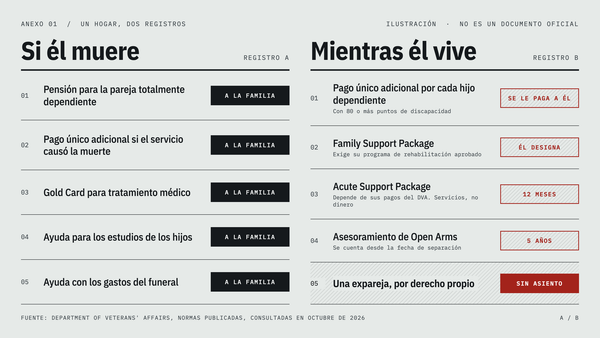
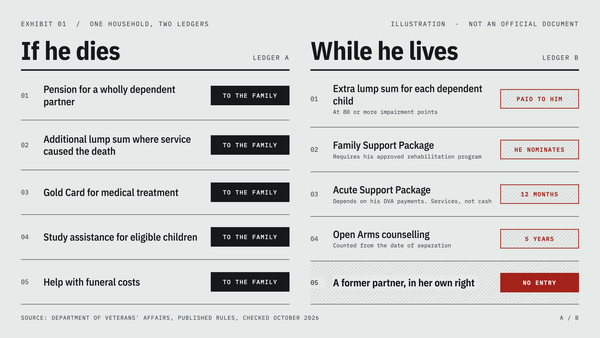
The entire architecture of Australian veterans' welfare is built around the veteran as the subject of harm and the subject of entitlement. The spouse exists in this system, if at all, as a carer or support person. There is no category of secondary casualty. There is no entitlement for the partner of a quinoline-affected veteran who has herself sustained harm as a direct and foreseeable consequence of the trial conducted on her partner.
I did not fail to access support because I did not look for it. I did not find adequate support because it did not exist. The gap between those two things is not a personal failure. It is a policy failure — specific, documentable, and attributable to institutions that have had more than twenty-five years to address it and have chosen not to.
Where responsibility truly sits
This series is not about vilifying my former husband. It is about finally understanding who he was, what he was living with, and where responsibility truly sits.
Responsibility sits with the Australian Government and the Australian Defence Force, whose decisions and systemic failures created the conditions in which this harm occurred.
The government authorised and funded the Army Malaria Institute drug trials in which mefloquine and tafenoquine were administered to ADF personnel, in many cases without adequate informed consent and at doses exceeding approved limits.
The ADF failed to conduct systematic neurological follow-up of affected veterans, allowing undiagnosed brain injuries to go untreated in households across the country.
The Department of Veterans' Affairs created a claims system that financially incentivised misdiagnosis — rewarding the wrong diagnosis and the wrong treatment, indefinitely, while the neurological substrate of dangerous domestic behaviour remained unaddressed.
No institution — DVA, Defence, domestic violence services, the family law system, or the criminal law system — has ever established a framework for recognising or responding to the secondary harm experienced by the partners of quinoline-affected veterans.
When a government administers drugs to service personnel in the context of formal clinical trials, it accepts a specific duty of care to those trial subjects. That duty does not end when the deployment ends. It extends to the foreseeable consequences of the injury those drugs may cause — including the consequences experienced by the families living with those injuries. That duty has not been discharged.
What I know now that I did not know then
I know now that the behaviour I lived with had a cause. I know its name, its neurological mechanism, its regulatory history, and the institutional decisions that produced it and then concealed it.
I know now that the treatment my former husband received was calibrated to the wrong condition — and that there is a body of peer-reviewed clinical literature that explains precisely why treatment designed for PTSD does not address quinoline-induced acquired brain injury.
I know now that the frameworks available to me — the domestic violence sector, the family court, the veterans' affairs system — were not designed for this situation and could not have been, because no institution had established the framework that would have made this situation legible.
I know now that what happened to my family was not inevitable. It was the foreseeable consequence of a series of institutional decisions — to administer the drugs, to suppress the adverse event data, to misdiagnose the injury, to provide the wrong treatment, to ignore the families — each one compounding the last, across more than two decades, in a system that has still not been held accountable for any of it.
What I am asking for
Not sympathy. The accurate account.
The investigation that should have happened. The recognition that is long overdue. The acknowledgement that what was done to my former husband was done, through him, to me and to our children — and that the institution responsible for that chain of harm has not yet answered for it.
I was just the army wife. I was never supposed to be visible in this story. That invisibility was not incidental. It was structural. It was designed into the system that administered the drugs, monitored only the veteran, compensated only the veteran, and built every support pathway around the veteran — as though the household he returned to was not full of people whose lives would be shaped by what those drugs had done to his brain.
I am visible now. This series is part of why.
If you or someone you know needs support: Open Arms 1800 011 046 · Lifeline 13 11 14 · 1800RESPECT 1800 737 732
Key sources
- Senate Inquiry report and submissions, December 2018 — Parliament of Australia. Particularly Submission 94 (McCarthy) and Submission 16 (Australian Quinoline Veterans and Families Association, including Professor Quinn's evidence).
- Royal Commission into Defence and Veteran Suicide, Final Report, Volume 4, Chapter 22, September 2024.
- Ritchie EC, Block J, and Nevin RL. Psychiatric side effects of mefloquine: applications to forensic psychiatry. Journal of the American Academy of Psychiatry and the Law, 2013.
- Nevin RL and Ritchie EC. The mefloquine intoxication syndrome. In Post-Traumatic Stress Disorder and Related Diseases in Combat Veterans. Springer International, 2016.
Related reading
- Previous in the series: Coercive Control in the Home
- Next in the series: Left Behind
- Just an Army Wife — No One Protects Us from Domestic Violence
Part of Unacknowledged Casualties. Read the full series at /unacknowledged-casualties/