The Quiet Yes
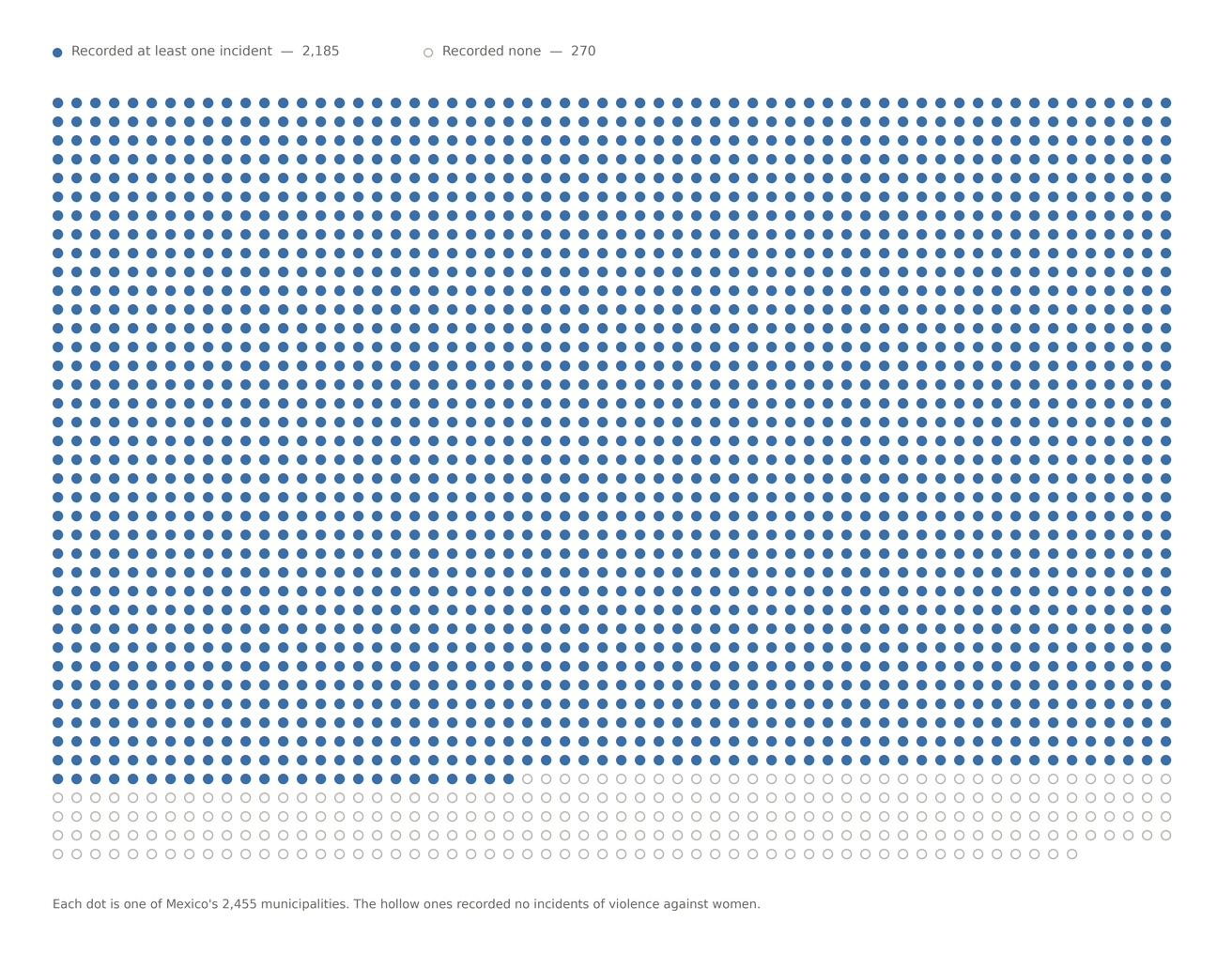
I learned who the bad men were within weeks. I never reported them. Eleven per cent of Mexico's municipalities record no violence against women at all.

Versión en español: El sí callado
In a small community, saying no to sex costs a woman more than saying yes. Her safety, her name, her income, her place in the town. So she says yes — and from the outside, it looks like consent.
I lived in a town like that, and it happened to me. Not something I watched from the outside. Something I lived through. This is what it was, what the research says about it, and why the women still there cannot write it for themselves.
Living in a small community in Mexico while I was homeless, it did not take me long to learn who the bad men were. I mean the men I would not want anywhere near my daughter.
They were predators of different kinds. Two of them stood out. In my experience they were dangerous — but who would believe me?
I was not young when it happened. I had experience. I knew what was going on and I knew how to keep myself safe. So I carried their dirty little secrets for as long as I had to. Some had wives and children. The vast majority were single.
What it was actually like
One was married, with children. He wanted to take me into the bushes and put his hands down my pants for fifty pesos.
One followed me around at night, touching himself in front of me. He was always high. One night he was too drunk to stand up.
One sat down beside me in the plaza and asked me to come home with him. Every time I said no, he had another reason why I should. He asked me again and again over three years.
One at the beach wanted oral sex in exchange for drugs. One in the cornfields wanted sex, hiding from his wife. One did not bother with any of it and said it to me in the street, in English: suck my dick.
There were others. I am not going to list them all. And every one of these happened more than once.
It sounds almost funny, written down like that. It was not funny. It was constant, and it was exhausting.
There was a pattern to it. Only one of them ever approached me in daylight, the man who wanted to take me into the bushes. The rest were night men. Always alone, always after the streets had cleared, when everything was quiet and everyone was asleep.
Which is another way of saying that women should not be out at night there. I was the exception. I was homeless and broke, for reasons that belong to another story, and at the time I told myself I had it under control. I did not.
Then Carlos.
He tried to rape me. It was a struggle, but I got away. I know exactly who he is, and I know how it would go if I reported it: his word against mine, and he moves in the circles that hold the power in that town.
I did not report it because I knew it would achieve nothing. It would cause gossip and upset families. Some of these men had wives. Say something, and I am the homewrecker. I am the one causing trouble. The research says the same thing. Reporting often achieves nothing, and it can make life much worse for the woman who does it.
Carlos was the worst of them, and he did frighten me.
He is not the reason I left. I was already going, and had been for a while. But he confirmed I was right. Next time I might not get away.
Not long after, three kind women gave me a way out, and I did not hesitate. I knew too much about the men in that town, and knowing too much is its own kind of danger. There was nobody I could tell. Not with the roads empty at night and the same men still driving them.
Why I can write this and they cannot
I am not writing this to make fun of that town. I lived there. I understand why it is so hard to speak out, because I did not speak out either.
But I was older when it happened, and I had experience. I could read those men. I could make decisions about my own safety. I had no family there, no husband, no name to protect. I could leave any time I wanted.
Almost none of that is true for the women who stay.
That is the only reason this article exists. It is not bravery. It is that I can speak without paying for it, and they cannot.
It is not bravery. It is that I can speak without paying for it, and they cannot.
The quiet yes
This is the part outsiders miss. In a small town, a woman's yes is often not desire.
Sexual compliance is saying yes on purpose, to avoid a fight, to keep the peace, to stop something worse from happening. An active yes, given for reasons that have nothing to do with wanting it.
Sexual acquiescence is not saying no. It is going still and waiting for it to end.
Neither one is consent. Both look like consent from the outside. That is exactly why they work so well for the men who rely on them.
Some men know this and use it. They do not force anything. They follow you, they keep talking, they wear you down over days or weeks until you say yes just to make it stop. Then they can tell themselves, and anyone who asks, that you agreed.
I am not going to say which of these men I said yes to, or whether I said yes at all. That is nobody's business, and it is not the point.
But notice that I still feel I have to explain myself. Years later, in another country, safe, I am still working out how this will be read and what people will think of me. That fear did not come from nowhere, and it did not stay behind in that town. It is the same fear that keeps women there quiet, and it travels.
That is what a quiet yes costs. Not the moment. Everything after it.
That is what a quiet yes costs. Not the moment. Everything after it.
A list that means nothing
I have a list of men in that town whose behaviour worries me.
Not proof. Not an accusation. A list. Men who will not take no for an answer. Men who offer money for sex. Men who walk the streets at night looking for a woman on her own. Men who follow you and keep on at you until you give in.
I am not diagnosing anybody. What I have is a pattern, the same behaviour from the same men, repeated over three years. One incident tells you nothing. Repetition tells you something. A man who asks once has misread the situation. A man who asks a hundred times, always at night, always when you are alone, is not misreading anything. He is working through the odds.
Legally, that list is worth nothing. A man is not a sex offender until a court says he is, and no court is ever going to say it, because nobody is ever going to report him.
So what do I do with it? Who would take it? Who would actually care? Some of the parents might. Some of the wives might. But most likely, nobody wants to know.
That is how these towns work. It is easier to act as though the problem is not there. And while everybody is pretending, nothing gets built to protect the next lot of girls growing up in it.
Eleven per cent of Mexico reports nothing
For a long time I thought this was just my bad luck. My bad decisions. My particular corner of one particular town.
It is not.
In 2026, researchers built a risk index covering all 2,455 municipalities in Mexico, using 411,631 reported incidents of violence against women. Eleven per cent of those municipalities reported nothing at all. Not a few cases. None. City municipalities recorded, on average, seventeen times the risk of the small ones.
The researchers do not think those places are safe. They think the reports are not being made, and the services are not there to take them.
I know what a zero looks like from the inside. It looks like a town where everyone knows and nobody files.
I know what a zero looks like from the inside. It looks like a town where everyone knows and nobody files.
The rest of the country tells the same story from the other direction. About half of Mexican women aged fifteen and over say they have experienced sexual violence in their lifetime. In one rural community in Chiapas, researchers found that 66% of women who had ever had a partner had been hurt physically or sexually by him. Of the women who experienced that violence, the 2021 national survey found only one in five asked for help or made a report. Around nine in ten sexual violence cases in Mexico never become an investigation.
Half the women. Nine in ten cases going nowhere. And on the official map, whole regions are blank.
Five walls
None of this is a mystery. Researchers have documented the same five barriers in small communities on four continents.
Everybody sees everything. There is no privacy in a small town. A woman cannot see a doctor, walk into a police station, or sit with a counsellor without people knowing by that evening.
Studies of rural survivors in the United States found this lack of privacy was the barrier they named first. A study in rural Tanzania found the same, and named the cost: the shame of everyone knowing, on top of whatever her neighbours decide to do about it.
He is not a stranger. In small communities, the man is almost always someone she knows. A partner, an ex, a friend, a neighbour. Naming a stranger costs a woman nothing socially. Naming a local man costs her the whole town. Families split, friends take sides, and the pressure lands on her to be quiet rather than on him to stop.
Money. In poor communities, silence pays the bills. Research in rural Kenya found families weighing a girl's disclosure against losing the man who feeds the household. Research in South Africa found the adult version: reports made, then withdrawn a few days later, after the family sat down and worked out they could not survive without his wages. The pressure does not arrive as a threat. It arrives as arithmetic, and usually from other women.
The pressure does not arrive as a threat. It arrives as arithmetic.
Nothing is nearby. A right you cannot reach is not a right. Many small towns have no trained examiner and no shelter. Getting an examination or legal help can mean hours of travel, money for the bus, and time off work you do not have. In Mexico, the shelters serving Indigenous and Afro-Mexican women have had their funding squeezed since 2021. Often there is no interpreter, which makes filing a report almost impossible for a woman who does not speak Spanish.
The police are local too. In a small place, the officer taking the report may be a friend of the man she is reporting. Researchers looking at the Mexican system describe a working assumption that violence has to be extreme before it is worth acting on.
Women in these towns are not confused about their options. They have watched what happens to women who try. They are making an accurate prediction.
One thing needs saying plainly. Men in small towns are not worse men. The difference is that a small town has none of the things that hold men in check elsewhere. No anonymity, no independent police, no shelter to go to, no way for a woman to keep a roof over her head on her own. The place protects him and traps her.
And it is rarely the man with a criminal record. It is the respected one. The good neighbour, the reliable worker, the man with a wife and children and twenty years of goodwill in the bank. When a man like that is accused, the town's first instinct is disbelief, and the woman has to prove herself against his whole reputation.
Those men treat all of this as ordinary. It is not ordinary. And the women are not behaving strangely, they are behaving sensibly. It is what they have to be sensible about that should never have become normal.
Why it hasn't been fixed
The comfortable answer is that this is a solved problem waiting on money. The research does not agree.
A 2025 review looked at every study of sexual violence in country areas of Australia published between 1996 and 2024. It found the same themes coming up again and again, and concluded that despite decades of campaigns, little meaningful change has occurred. Different country, different decade, same walls.
Reform is designed for cities. New laws and awareness campaigns assume city infrastructure. Telling a woman she has the right to report means nothing if there is no transport to the station, no interpreter at the desk, and the officer drinks with her attacker.
Speaking gets punished. When women do speak, police, schools and churches often dismiss it, protect the more important man, and turn the questions back on her.
Silence gets passed down. Girls grow up watching what happened to the women who spoke. They learn to stay quiet, and they teach it to their daughters, because it works.
What helps is starved. The travelling advocates and quiet outreach programmes that do work run on short staff, long waiting lists, and no room for the women they turn away.
Is your daughter safe?
I have a daughter. She is not in that town, and I worry about her anyway. But after what happened to me there, I worry about the daughters who still are.
The honest answer is that no woman is safe in a place like that. She can do everything right. Be careful, avoid the men everyone warns about, stay close to home.
It will not matter. If a respected local man decides to hurt her, everything around her is arranged to hide it and keep her quiet.
Safety there will not come from women being more careful. It comes when she can speak without losing her income or her place in the town. When the person taking her report has no connection to the man who hurt her. When being well liked is no longer accepted as proof that a man is harmless.
None of that exists yet. Until it does, women will keep doing what I did. Working out that telling costs more than carrying it, and carrying it.
That calculation was not a personal failing. It is the system working exactly as it was built to work.
And somewhere in that eleven per cent, in the towns that report nothing at all, women are doing that arithmetic tonight.
Related reading
- The Beach Town Where Silence Is the Cartel’s Best Weapon
- Living With a Cartel Man
- The Unrefusable Payment
Línea 24 horas — violence against women. Free, national, 24 hours: 800 108 4053
Red Nacional de Refugios — the national shelter network. Not government, not police: 800 822 4460
Casa Gaviota — support online, if a phone call is not safe or not private: casagaviota.org
ADIVAC — medical, legal and psychological help after sexual violence. Mexico City: 5682 7969
Emergency: 911
You do not have to give your name to ask a question.
Sources
Violence Against Women Risk Index, Public Health (Elsevier), 2026. Municipal-level analysis of 411,631 reported incidents across Mexico's 2,455 municipalities.
ENDIREH 2021 (INEGI), National Survey on the Dynamics of Household Relationships, Mexico.
Institute for Economics and Peace, Mexico Peace Index.
Equality Now (2025), submission on sexual violence law and funding in Mexico.
Immigration and Refugee Board of Canada (2024), country information response on gender-based violence in Mexico.
Intimate partner violence and common mental disorders in a rural community of Chiapas, Mexico.
Logan, T. K., Evans, L., Stevenson, E., & Jordan, C. E. (2005). Barriers to services for rural and urban survivors of rape. Journal of Interpersonal Violence, 20(5), 591–616.
Community perceptions of rape and child sexual abuse: a qualitative study in rural Tanzania (2014). BMC International Health and Human Rights, 14:23.
"If You Are Raped, You Are Like Secondhand": Systemic Barriers to Reporting Sexual Violence Against School-Aged Girls in a Rural Community in Kenya. Sexes (2025), 6(1), 12.
Suffering in Silence: Reasons Why Victims of Gender-Based Violence in Higher Education Institutions Choose Not to Report Their Victimization. Social Sciences (2025), 14(6), 336.
Jones, R., Jackson, D., Rice, K., Usher, K., et al. (2025). Sexual Violence and Assault in Rural Australia: A Scoping Review of Regional, Rural, and Remote Contexts. Trauma, Violence, & Abuse.
Thiede, E., & Miyamoto, S. Rural availability of sexual assault nurse examiners. Journal of Rural Health.
Rural Health Information Hub, Violence and Abuse in Rural America.