The Beach Town Where Silence Is the Cartel’s Best Weapon
Inside Lo de Marcos, Nayarit, where peace is curated and the rules are unspoken. A first-hand account of how silence works in a cartel-adjacent town.


Versión en español: El pueblo de playa donde el silencio es la mejor arma del cártel
Inside Lo de Marcos, Nayarit — where peace is curated, rules are unspoken, and I learned the difference the hard way.”
People imagine Mexico’s criminal landscape as a single story — one cartel, one enemy, one headline. The truth is fractured, layered, and deeply local. Power here doesn’t move in straight lines. It moves in corridors, in pockets, in invisible borders that only make sense once you’ve lived inside them. My understanding of this world isn’t academic. It’s lived — grounded in proximity, exposure, and the quiet details that only reveal themselves over time.
Lo de Marcos was never a cartel town. But it was never untouched either. It sat in the middle — quiet, peaceful, strategically placed in a way most outsiders would never think to question. To understand what happened to me, you have to understand the landscape around me. Not the sensational version. Not the Netflix version. The real one — the one that operates in silence.
The Geography of Silence
Mexico isn’t controlled by one cartel. It’s a mosaic of groups, alliances, splinters, and rivalries. By the mid-2020s, analysts estimated that organized crime influenced roughly a third of the country’s territory — not through open warfare, but through presence. Through infiltration. Through the quiet kind of control that rarely makes headlines.
The Pacific coast is one of the most contested regions in that mosaic. Drugs move through it. Money moves through it. People move through it. And the cartels move through it too — not always visibly, but always deliberately.
Nayarit is tiny on the map, but its position is everything. It sits between Jalisco — home to the Cartel Jalisco Nueva Generación (CJNG) — and Sinaloa, the historic northern powerhouse. It borders the Pacific, a maritime highway, and the Tepic–Guadalajara corridor, a land route that matters more than most people realize. Nayarit isn’t a headquarters. It’s a buffer. A place where control matters more than spectacle.
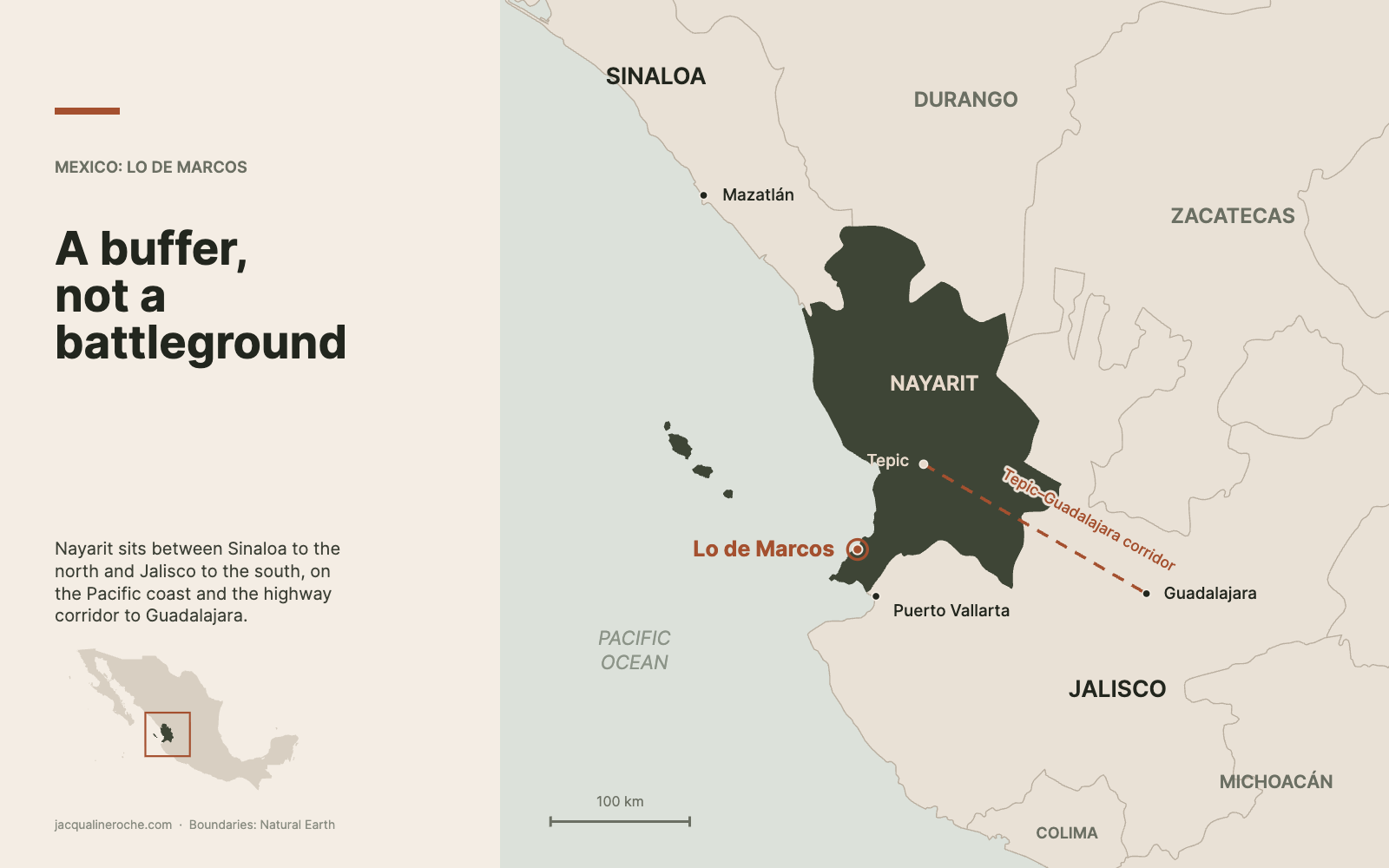
CJNG dominates the central and southern parts of the state; Sinaloa’s influence presses in from the north. Neither needs open conflict in every town. They just need balance. Predictability is profitable.
CJNG is often described as explosive, violent, theatrical — and across Mexico, that reputation is earned. But in Nayarit, their model looks different: parallel authority structures, local infiltration, informal “taxation,” community-level intelligence networks, and a preference for silence over spectacle. They don’t need to terrorize every town. They just need every town to understand the rules — rules that rarely need to be spoken aloud.
A Buffer, Not a Battleground
Lo de Marcos is not a cartel stronghold. It’s a small coastal town built on tourism, routine, and the illusion of peace — the kind of place where everyone knows everyone, and everyone knows when not to ask questions. That’s exactly why it matters. Sitting inside CJNG-influenced territory, with Sinaloa’s presence pressing from the north, it isn’t a battleground. It’s a buffer. A quiet zone where nothing dramatic is supposed to happen. That’s the point.
Cartels don’t want chaos in towns like this one. They want calm, predictability, invisibility. Violence draws attention. Attention draws authorities. Authorities disrupt business. So instead of convoys or shootouts, you get something else entirely: presence, observation, silence, compliance. Control that doesn’t look like control at all.
People ask why a quiet beach town would be touched by cartel dynamics. The answer is simple: geography. Lo de Marcos sits on a coastline that matters, on a highway that matters, in a region where two major criminal organizations have overlapping interests. You don’t need a headquarters to feel the influence. Proximity is enough.
Lo de Marcos isn’t defined by cartel presence — it’s defined by cartel absence, and that absence is curated. Geography provides convenience. Tourism provides cover. Economics provide opportunity. Silence provides stability. The town isn’t a façade; it’s a function — a deliberate equilibrium maintained by forces that understand the value of quiet.
In big cities, cartels might block highways or clash openly with authorities. In rural areas, they might rely on drones or intimidation. In small towns like Lo de Marcos, the methods are softer, more psychological, and far more effective: a look that lasts one second too long, a favor you didn’t ask for, a silence that spreads through the community, a warning that never sounds like a warning, a pattern that repeats until you understand it without being told.
This isn’t the violence people imagine. It’s the violence people don’t see.
A Mutual Performance
Lo de Marcos survives by pretending nothing is happening. The cartel survives by pretending it isn’t there. It’s a mutual performance, and everyone knows their role. Tourists see a peaceful beach town. Locals see a place where life goes on as long as no one asks the wrong questions. The cartel sees a stable environment that serves its interests. And I saw the cracks — the quiet movements, the patterns, the silences that didn’t make sense until they did.
What happened to me wasn’t random, personal, or dramatic. It was the small-town version of cartel presence — the version that thrives on invisibility, that dismantles a life quietly, piece by piece, without ever disturbing the surface. People imagine cartel control as a war zone. In Lo de Marcos, it looks like nothing at all. And that’s exactly how they want it.
Every quiet town has rules, even if no one writes them down: keep the town calm, keep the economy moving, keep outsiders comfortable, keep attention elsewhere, keep the streets safe, keep the beach untouched. A town like Lo de Marcos is more valuable quiet than conquered.
Beneath the Quiet
And beneath that quiet, the town remains what it has always been: a relaxed, authentic coastal community in the Bahía de Banderas municipality. A wide, empty beach. Wetlands full of birds. A year-round population of two to three thousand. A Saturday tianguis. A handful of shops. Humpback whales breaching close enough to see from the sand. A place that feels untouched, safe, simple.
And yet the same quiet logic applies underneath: silence is stability, stability is profit, and profit is power. Power, in places like this, is always present — especially when it pretends not to be.
Should You Still Go?
People often ask whether they should visit Lo de Marcos. My answer is yes. Don’t let my experience deter you. What happened to me isn’t common — the bullying and harassment I endured is rare for tourists, highly unlikely though never impossible. Threats exist everywhere, even at our own backdoor.
My experience is simply a window into what can happen, and how to recognize the signs if something ever feels off. If there’s a next time — which I hope there never is — better reporting mechanisms matter. Persistence matters. Reporting serious incidents sooner rather than later matters.
And still, I love Lo de Marcos. I love the people — the full-time locals, the long-term visitors, even the crews from neighboring towns, the families who return year after year. I would absolutely recommend visiting. It’s a quiet, authentic seaside town that hasn’t been swallowed by tourism, where locals and visitors coexist comfortably in a balance that’s rare along the Pacific coast of Nayarit and Jalisco. It remains a well-kept secret — one people hesitate to share. Perhaps now you understand why.
A Dozen Lives in One Place
I felt like I lived a dozen lives in Lo de Marcos in a very short time — so many little worlds folded into one place. I arrived as a tourist and left as a homeless woman. In between, I moved through layers of life most people never see. I experienced the town as a visitor, then as a local, settling in while my children thrived at a tiny school over the hill in Las Lomas. I fell in love. I brushed up against the cartel world. I lived on the streets. I formed friendships with people most outsiders never meet — cartel-adjacent workers, drug users, the homeless, the ones who survive in the shadows of a place that looks peaceful from the outside.
Does that sound bad, or is that simply life? A life I will never forget, because living in so many worlds meant living at so many levels, alongside people most tourists will never notice, let alone understand. And if you do visit, remember this: all families are equal, no matter what role they play within the community or just beyond it. The homeless have their own stories too, and they’re rarely what you expect. Mine began with domestic violence and ended with addiction.
Lo de Marcos is a place defined as much by what is visible as by what is not. Its calm is real, its beauty undeniable, its people steady in a way that anchors the town’s rhythm. I’d still tell people to go — to walk the beach at dawn, to sit in the plaza at dusk, to see the version of Mexico that rarely makes the news. But understanding the quiet forces that shape a place is part of understanding the place itself. Lo de Marcos remains a well-kept secret, and like most secrets in Mexico, its silence tells its own story.