When a Man Points a Loaded Gun at Your Head, How Does That Change You?
My husband pointed a loaded pistol at my head, and our four children saw it. An afternoon in Lo de Marcos, July 2017, and what it changed.
Versión en español: Cuando un hombre te apunta a la cabeza con una pistola cargada, ¿cómo te cambia?
My husband pointed a loaded pistol at my head, and our four children saw it.
We had lived in Lo de Marcos since the end of 2016. It was a small fishing village on the Pacific coast of Nayarit, small enough that everyone knew the shape of everyone else's days. The children settled quickly. They went to school, learned Spanish, played baseball in the dusty field behind the school, and took art classes in a room that smelled of paint and sea air. After school they ran to the plaza at the centre of the village, with its gardens, its swings, and its benches in the shade of the jacaranda trees. There were always people there: families, neighbours, children on bikes. The plaza was where my children were happiest. It was the only place that felt safe to me too.
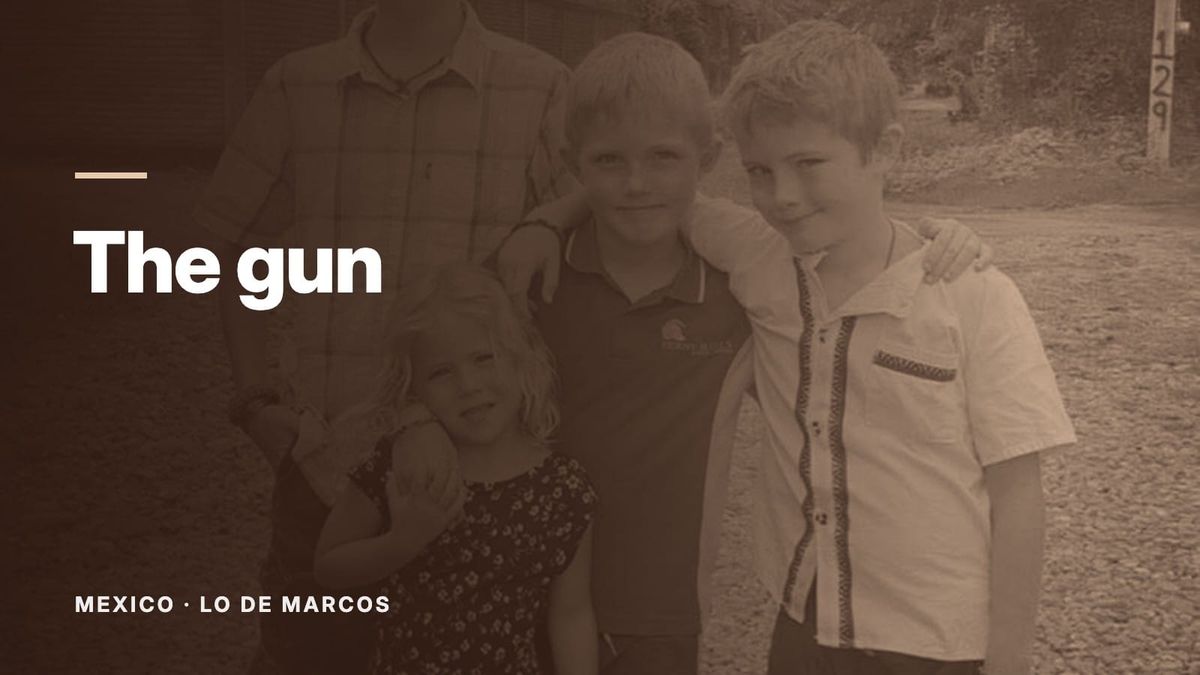
Mark was thirteen, the eldest. He noticed things. He put himself between the younger ones and whatever was wrong without being asked. Matthew was nine, softer and more open, the kind of child who would reach for your hand in the middle of an ordinary afternoon for no reason except that he wanted to. Joshua was eight, quick and curious, always heading for whatever was most interesting. Sarah was five. She loved her brothers completely and belonged equally to all of them.
The house was different. It was a two-storey rental out towards the highway, away from the town and the plaza, and the front door opened straight onto the road. Their father drank, and he took prescription drugs and illicit drugs, and I never knew which version of him I would find when I came home.
He kept a pistol in the house. He had brought it into Mexico from the United States without declaring it. It was always loaded and always within reach, and he was never careful with it. When he was drinking or high, he waved it around, threatening harm, or threatening himself. He had fired it inside the house more than once.
We had learned to leave. When the air in the house changed, I would say, Let's go, and the children would put on their shoes and follow me out the door. They didn't argue, and they didn't ask why. We went to the plaza, because there were always people there. The plaza always felt safe.
That was how we lived before that afternoon: a village that was giving my children a life, and a house where we listened for footsteps.
It was July 2017, the school holidays. The weather had turned cold, and it had rained on and off all day, the kind of grey afternoon that makes a house feel like shelter. I had collected the children from a school holiday program. They still carried the loose, half-tired energy of a day spent with other kids, already thinking about food, about rest, about nothing in particular.
We came through the door together, and the music hit us first. AC/DC, "Back in Black," blasting loud enough to fill the walls, loud enough that you couldn't hear yourself think. He used sound the way some men use silence. Both were warnings, if you knew how to read them.
I went upstairs. He was standing on the balcony in a black T-shirt and black shorts. He always wore black.
Then he raised the gun.
Do you want it to be over.
It was not a question.
The children were coming up the stairs behind me. Matthew was first. They all saw the gun.
I told them to go downstairs and wait for me. They went. They didn't argue. They didn't ask why. They had done this before.
Then it was the two of us. I stood facing him and could not move. The angle of his arm. The change in his breathing. The music still playing, as if nothing in the world had changed. Neither of us spoke.
José was a friend of ours. He had just arrived to help my husband with some errands. From the road, he had seen my husband on the balcony with the gun. He came up the stairs, talking to him, and he stepped between us. The gun could no longer point at me.
He asked him to put the gun down. Come on, he said. You don't want to do this. Not in front of the children. Let's talk about it.
With one hand behind his back, he signalled for me to go downstairs.
I started down the stairs. As I went, he told me to take the children to the plaza and wait there.
My hands were shaking. My heart was pounding. I walked down with my back to him and the gun.
It all happened quickly once José arrived. I don't know what I would have done if he hadn't been there.
The children were waiting out on the road, where the front door let out. I reached them, and we walked into town, the way we had walked it many times before.
That afternoon the streets were empty. It was getting cold, and a light rain had started. It was not a time to be outdoors.
I don't remember their faces in those minutes. I have tried, and I can't bring them back.
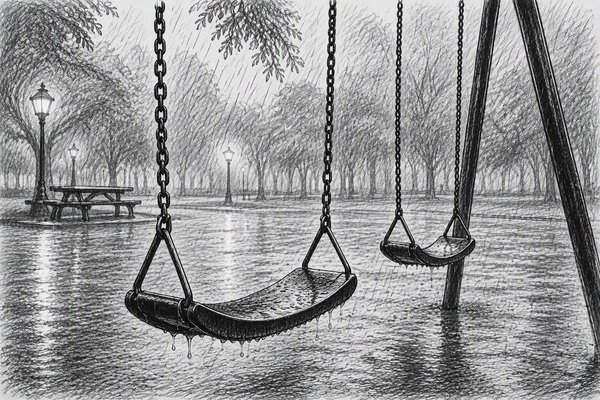
The plaza was empty too. The gardens, the swings, the benches under the jacaranda trees, and no one in any of it. No families, no neighbours, no children on bikes.
But it was still our safe place. It was the only place in the whole town where I felt my children were safe, and it did not matter whether there were other people there or not. It must have looked odd, the five of us alone in the plaza in the rain. No one would ever have imagined why we were really there.
My phone rang. It was José, still at the house with my husband. He told me not to come back. He said to wait there with the children while he calmed him down, and he would call me when he had worked out what we could do next.
We waited two hours.
The children went to the swings, the way they always did. For a while, in the cold, they played as if it were any other afternoon.
Sarah looked up at me from the swing.
Do we have to go back?
None of them wanted to go back that day. I did not want to go back. But we had nowhere else to go, and no one to turn to. No one would understand.
Not yet, I said.
She kept swinging. The question was already gone, because she was five, and the swing was still moving, and I was still there.
After a while the rain stopped, and other children came out to play. It started to feel like a normal day again. Sarah was giggling with two other girls around her. The boys were with their friends by the stage at the back of the plaza.
One other parent came. She didn't speak English, and I didn't speak Spanish. I didn't want to say anything. I didn't even want to lift my head and smile. All I wanted was to keep watching my children. Watching them smile. Watching them laugh. Watching them play with other children.
In a way, I was frozen. I stood there and could not move. I wanted the day never to end. I wanted my children to stay happy. I wanted to stay at the plaza with them forever. I did not want to leave.
Not long before, they had watched their father point a gun at me. Now they were playing, and the only thing they didn't want was to go home. They weren't only surviving him. They were surviving with me. That was when I knew something had to change.
I don't remember what else I said to them while we waited. I know the rain came and went. I know no one asked us what was wrong. I know I was waiting for the phone to ring. Some moments of motherhood are beyond retrieval — not because they didn't matter, but because the mind was spending everything it had on the one task that did: keeping them calm, keeping them close, keeping them.
Then José came for us in his little old white truck and drove us back.
The music had stopped.
We walked through the door into a house that looked the same as it always had. I cannot remember where the gun was. He had been drinking. He had also taken too many prescription drugs, and illicit drugs. I don't remember whether he said anything.
That is the thing about this kind of violence: it leaves no mark on the walls. Only on the people inside them.
At the plaza, I had known something had to change. But knowing is not the same as leaving.
This is the hardest part to explain, and the most important. I didn't understand how serious it was at the time. I was in shock. I wasn't able to think. A gun pointed at my head became one more measure of the violence I had been living with for years, one more thing to absorb.
And there was nowhere to go. Every dollar we had came through him, and there were four children to feed and get to school. We went back into the house, and we stayed.
What began that afternoon did not end when the door closed behind us. It settled into my body: into my breathing, into the way I began checking every room for the way out, listening for his tone, his footsteps, the change in the air before things went wrong. For a long time, I did not connect any of it to that day.
I still have bad dreams about that afternoon. I still see how it might have ended.
Set out plainly, the way a report would have set them out, the facts of that afternoon are these.
A loaded pistol, brought into the country undeclared, kept within reach in a house with four children.
A man who had been drinking, and who had taken prescription drugs and illicit drugs.
A gun pointed at a woman's head, with words that said what he meant: Do you want it to be over.
Four witnesses, aged thirteen, nine, eight and five.
One intervention: a friend who happened to arrive at that exact moment.
No report. I was too scared to report it. I only found the courage months later, after he had left the country, when I went to the Ministerio Público in Sayulita. I hated myself for not reporting it at the time. I hated myself for being so scared of him. I hated myself for never standing up to him. He scared me in ways it has taken me many years to put into words.
No way out. At the time, I felt there was no way out. We went back into the same house, with the same man, because there was nowhere else to go.
Researchers who have studied women killed by their partners found that a partner's access to a gun, and a threat already made with a weapon, are among the strongest warning signs. A partner's drug use raises the risk further.1 By the time we came home from the plaza, our home held all three. What I felt at the top of those stairs was not only fear. It was what the research already knew about homes like ours.
I didn't know any of that then.
Nothing stopped him that afternoon except one man's timing. There was no system in place, and no record was made that day. The complaint I made in Sayulita seems to be lost now. I have contacted the Nayarit government many times since. Because it all happened in another country, no one has been able to act on it, and the red tape has become one more way of reliving that afternoon over and over again.
The protection my children had that day was a friend on the road, and an empty plaza in the rain.
My children were thirteen, nine, eight and five when they came up those stairs. They saw their father point a loaded gun at their mother's head. When I told them to go downstairs, they went, because they already knew how.
I don't know what that afternoon did to them. I know what they saw.
The answer is not complicated.
It changes one thing.
Everything.
Related reading
1 Jacquelyn C. Campbell et al., "Risk Factors for Femicide in Abusive Relationships: Results From a Multisite Case Control Study," American Journal of Public Health 93, no. 7 (2003): 1089–1097.