The Question Underneath
“I spent years trying to prove what happened to me in that small town in Nayarit. It took even longer to realize that proof was never what I was actually seeking.”

Versión en español: La pregunta que hay debajo
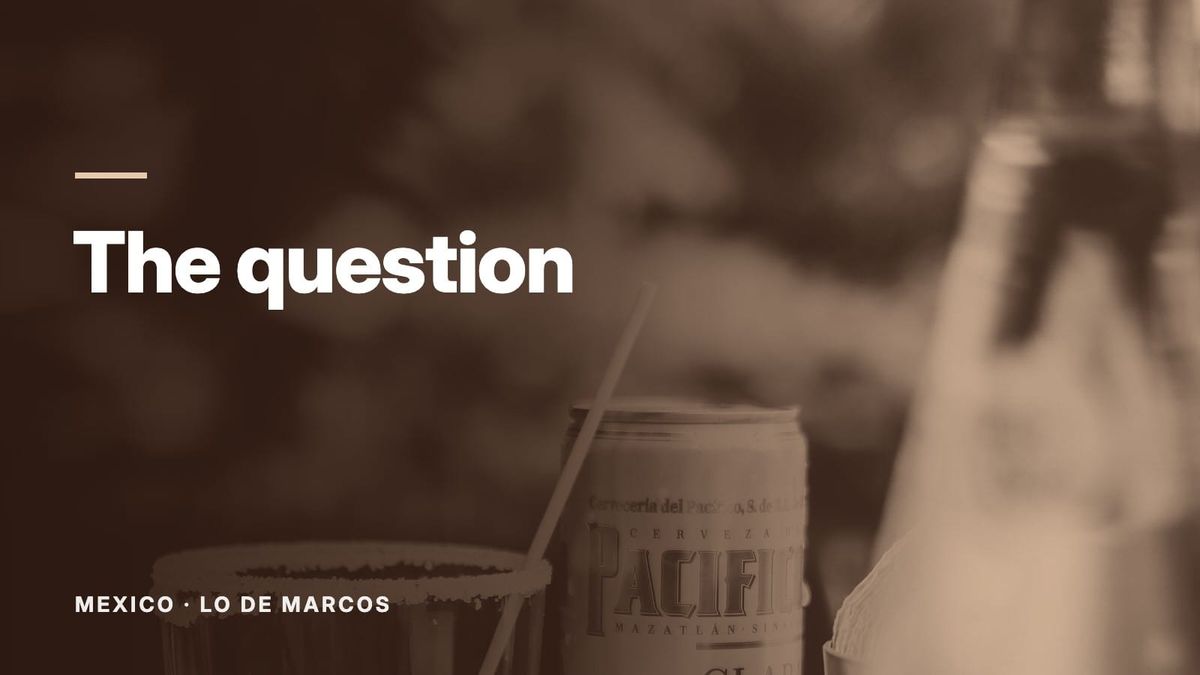
The bottle arrived at the house. A large one, the kind sold cold at roadside shops all along that coast. When I picked it up I could see the lid had been tampered with.
I want to be accurate about the order things happened in, because the order is the only part I am certain of. I noticed the lid. I drank anyway — a few sips, no more than that. And then, quickly, far faster than any amount of beer accounts for, I was incoherent.
I don't know what was in it. Nothing was kept, nothing was tested, nothing was analysed by anyone. By the time I could think clearly the bottle was gone and so was any window in which it could have been established. Whatever was in it exists now only as something I experienced and cannot demonstrate.
It happened twice.
Something was done to me during that period that I have never been able to prove. I am not going to set it out here. What matters is the shape of it: the proof was never mine to hold. It was made by other people, kept by other people, and would only ever surface if those people chose to expose themselves.
For a long time I thought that was the problem. No proof, therefore no investigation, therefore no resolution. I have written two essays on that closed circuit and I stand by both of them.
But somewhere in the last year I understood that I had the wrong problem.
Suppose it all arrived tomorrow. A forensic image of the phone. The carrier's records. The recordings themselves, in a sealed envelope, authenticated. Suppose someone with the authority to look had looked, and found everything, and put it in front of me.
I would still not know why.
That is the thing I actually want, and no amount of evidence produces it. Evidence establishes that something occurred. It does not explain why it occurred to a particular person. There is no forensic procedure that returns a motive, no warrant that compels an answer to the only question I have been asking since 2017.
Here is what makes it unbelievable, including to me.
I was a mother of four on a tourist visa in a small coastal town. I had no money worth taking — by the end there was almost nothing left, and what there was got extracted in small, clever increments over a long period. I had no business anyone wanted. I had no information. I was not in anyone's way that I ever became aware of. I had done nothing.
And the effort was enormous. That is the part that has never resolved for me. Sustained over months. Careful. Repetitive in a way that suggested procedure rather than impulse. Whatever it cost to run, in people and time and attention, it cannot have been recovered from a household that was already broke and getting broker.
I have turned that disproportion over for years and I have never found an explanation that accounts for it. Ordinary acquisitive crime does not work like that. You do not spend that much to take that little.
I am aware that this is the point at which accounts like mine usually reach for something larger — a purpose, a design, a reason that makes the effort make sense. I have felt the pull of it and I am not going to do it. I don't know why. The disproportion is an observation, not a theory.
I went back to Mexico eight months after I left with the children, on my own.
People assume the return was about closure. It gave me none. What it gave me was the ability to observe without also having to survive, and what I saw over the following years was a presence heavier and more organised than I had understood while I was living inside it. It ran quietly. Systems that run quietly are the ones that are working.
I am not naming the organisation. I've been consistent about that and the reason hasn't changed: it would be a claim about attribution I cannot support, and nothing in my account depends on it.
What I also came to understand is that the people who live there permanently read that town far better than I ever did. They have read it for decades. It is entirely possible that somebody noticed something — a vehicle, a delivery, a face that did not belong on that street.
And if they did, they would never say so. Not to me, not to anyone. Not out of indifference, but because saying it aloud in a town that size, about the people it would concern, is not something a person can safely do and continue to live there.
So even the answer, if it exists, is held by people who have excellent reasons never to give it. Not behind a warrant this time. Behind something no institution can reach.
The strangest thing I can tell you is that I wish I had imagined it.
I have wished that repeatedly and I mean it without qualification. It would be a smaller catastrophe. It would mean my mind had produced something under extraordinary pressure, which is ordinary and treatable and would not require anything of the world.
But I have never been able to get there, and the reason is not conviction. It is the mistakes. Blood on a laundry floor from someone who had been inside my house. A lid that had been opened before it reached me, twice. Things that went missing after I changed the locks. Individually each has an explanation. What I cannot do is dismiss all of them at once, and I have tried, because dismissing them would have cost me less than this has.
I don't have an ending, because the question doesn't close.
What I have is an hour I can't account for and a certainty that I did not do it to myself. Beyond that: no reason, no motive, no explanation for why any of it was worth anyone's while.
I used to think that if someone finally looked, I would get an answer. Now I think that if someone finally looked, I would get a finding — that something happened, or that it didn't — and I would still be standing in the same place, asking the same thing, which is not what and not who but the question underneath both of them.
Why me. There was no reason. That is the part I have never been able to put down.