The Knock
An extract from the book. January 2000, Townsville: the battalion came home from East Timor, and for a moment I did not know the man at my door.
Versión en español: Llamaron a la puerta
This is an extract from Chapter Two of the book I am writing about our years in Mexico and what came before. It begins in Townsville, in January 2000.
The knock came not long after New Year, in the thick wet heat of a Townsville January.
Nobody told me he was coming. There was no date, no time, no flight to meet. There was no crowd at the airport for me to stand in, no sign to hold up. I knew only that the battalion was on its way home, and that he would be home soon.
Somewhere there must have been cameras. Speeches, perhaps, and families waving. I have no memory of any of it. Whatever the rest of the country saw, I was not part of it.
For three and a half months I had written to him every three or four days, and I had kept a diary at night so that nothing of those months would be lost. I had imagined his homecoming more times than I could count. In every version, I was ready.
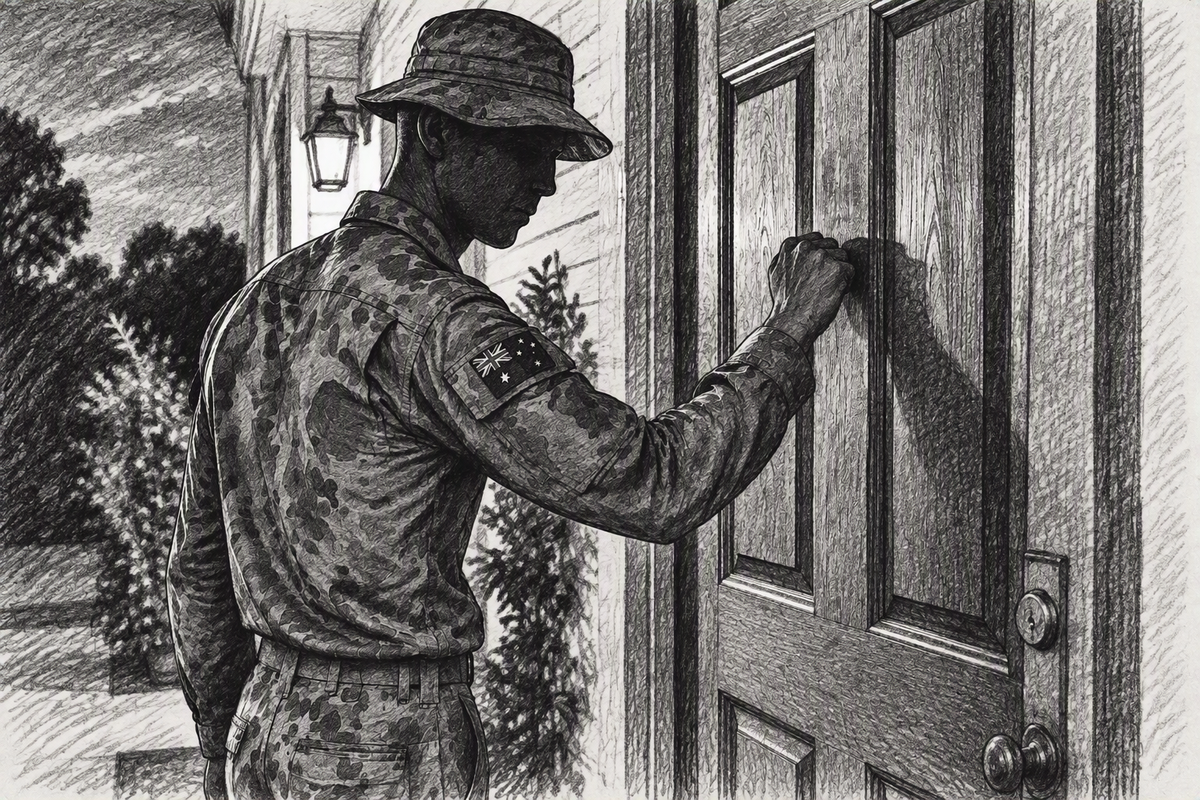
Then, on an ordinary day, someone knocked on the door.
I crossed the room and opened it.
A thin man was standing there.
I did not know him. For a moment, one long and terrible moment, I genuinely did not know who he was. He was too narrow for the doorway he was standing in. His clothes hung from his shoulders as though they had been made for somebody else. His face had sunk in around the bones, and his eyes sat deep in it, watching me.
Then I did know him.
It was the man I had said goodbye to in September. The man I had been writing to. The man I was supposed to have married by now.
I said his name. He smiled, and it was his smile, but it seemed to reach his face a moment late, as if it had travelled a long way to get there.
I put my arms around him and felt his ribs through his shirt.
Later he would tell me he had lost about twenty kilograms. At the time I did not need a number. I could feel it. I could see it. What I could not see was what else he had lost over there, and what he had brought home in its place. Or how much of myself I would give up, in the years that followed, trying to make room for it.
We were supposed to have been married by then.
We became engaged in 1998. The year before, on New Year’s Day, my twenty-third birthday, I had been out on Wellington harbour with a man I had known for less than two days. By March I had followed him to Townsville, and I never went home.
By the time he asked me to marry him, I had already forgiven him once for something no one should forgive. I had folded it away, the way I would learn to fold away so much. I told myself it had been one terrible night, and that the man who was kind to me the rest of the time was the real one.
He was attentive, and he was sure of himself, and he made me feel seen. He called me his princess. I took the word as a gift and never stopped to ask what it meant to him. A princess is cherished. A princess is also kept.
I believed we were in love. I believed he was the man he showed me. I needed to.
And I still had a life of my own. I worked as a scuba diving instructor, and in reservations and sales. I spent my days on the water and the reef, among people who were young and sunburnt and certain the world would keep its promises. I was good at what I did. I had my own money, my own friends, my own reasons to get up in the morning. I did not know yet how much of that I would hand over, one piece at a time, without ever noticing I was doing it.
In September 1999 he deployed to East Timor with the 2nd Battalion, Royal Australian Regiment, as part of the peacekeeping force. It was his first deployment. We were meant to be married six weeks after he left. Instead we postponed the wedding, and the date came and went with him on the other side of the Timor Sea. I was proud of him. I was frightened for him. I watched the news every night and read between its lines.
I did not know then that the army was running antimalarial drug trials on its soldiers.
The letters came and went. I wrote about small things, because small things were all I had to give him. I wrote about work and the weather and the people we knew, and I kept writing, every three or four days, because somewhere I believed the letters were keeping him safe. At night I wrote again, in my diary, the things I did not want to burden him with.
I do not have the letters any more. I do not have the diary. But I remember the act of writing them, the habit of reaching across the distance to him, and how certain I was that the man reading them was the same man who would come home.
In the first days after he came back, he slept, and he ate, and I watched him.
He told me he had gone as a lance corporal. He told me he had worked in the operations room at battalion headquarters in Balibo, close to the border. He told me about the weight. He did not tell me much else, and I did not know how to ask.
I told myself it was exhaustion. I told myself every soldier came back strange for a while, and that the man I knew would surface again once he had rested and eaten and slept in his own bed. Some of him did come back. Enough of him came back that I could keep believing the rest was on its way.
He has always said he was part of the antimalarial trials, on that deployment and on the one that followed. I have never been able to confirm it, and in all the years since, nobody has been able to tell me what those drugs did, or did not do, to the man who knocked on my door. Years later, Veterans’ Affairs paid him compensation, which told me only that someone, somewhere, had accepted that something had happened. Not what. Never what. I stopped waiting for that answer a long time ago.
What I have instead is the question. And the memory of a stranger standing in my doorway, wearing the face of the man I loved.
For a long time I made that question the centre of my life. It was easier than asking what was happening to me.
Want to read the rest? Join the list to hear first when pre-orders for the book open.
Related reading: Neither Verdict and What the Record Would Not Hold.
If you need support. Australia: 1800RESPECT 1800 737 732 · Open Arms 1800 011 046 · Kids Helpline 1800 55 1800. New Zealand: Emergency 111 · Women’s Refuge 0800 733 843 · 1737 (call or text). Mexico: Línea Nacional Vida Sin Violencia 800 108 4053.


