Everything You Did Was Right: Complex PTSD and the Town That Stayed
For years I didn't know I was living with Complex PTSD. A small town in Mexico didn't know either, but it treated me with a kindness that helped me heal. This is my thank-you.

Versión en español: Todo lo que hicieron estuvo bien: el TEPT complejo y el pueblo que se quedó
A thank-you, years late, to the people who carried me before I knew what I was carrying
I arrived as part of a family. I want you to remember that first, because by the end it was the last thing most of you would have guessed.
There was a husband. There were children. There were suitcases and plans and the ordinary hope of people starting over somewhere new. A handful of you met us in those first weeks, before anything had come apart. You knew me as a mother, a wife, a newcomer fumbling with the coins and the language. You are the ones who knew who I was. For a long time, you were the only ones who did.
Then the marriage broke. Then my children were gone from me. And then, quietly at first and then not quietly at all, so was I.
What you saw
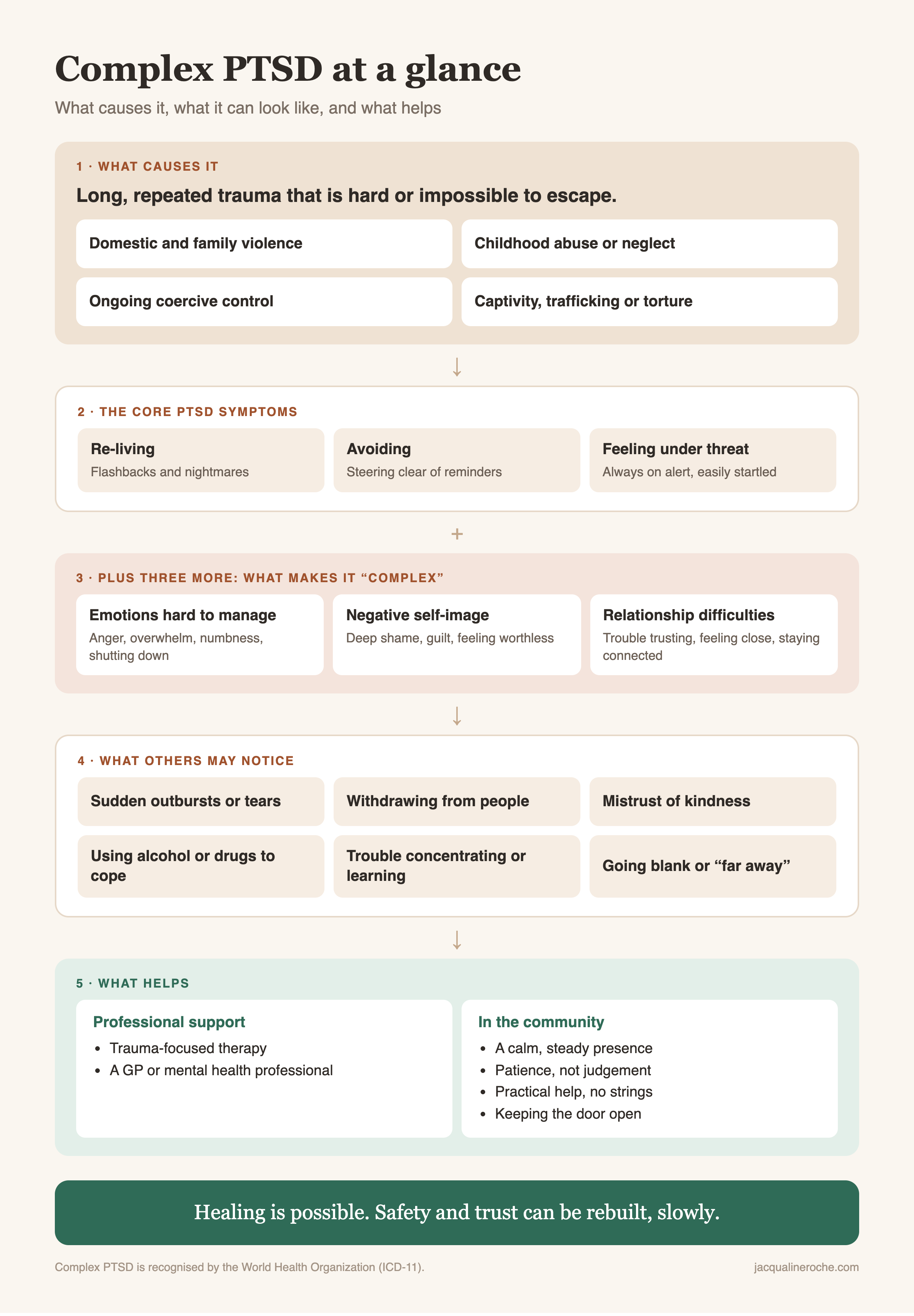
I didn't have a name for it then. I need to be honest about that, because everything else rests on it. I didn't know I was living with Complex Post-Traumatic Stress Disorder. I didn't know that long before I ever set foot in your town, something in me had learned to treat the whole world as a place that would hurt me. I only knew that I was frightened all the time, and that the fear came out of me as fury.
What none of you could have known, and what I barely understood myself, was where I had come from. For twenty-one years I lived inside a violent marriage. There was no way out of it. In the end it wasn't courage that set me free, or a plan, or a locked door finally opening. It was distance. Countries came between us, and the thing I had survived for most of my adult life was suddenly, simply, over.
That is when it began. That is the cruelty of this condition: it waits. Complex PTSD grows out of harm that is long and repeated and impossible to leave, and so often it does not surface until the danger has passed and the body finally has room to fall apart. I know that now. I have a diagnosis, a name for what came for me in your streets. Back then, all any of us had was a woman shouting.
You saw the storms. Moods that turned without warning. The fury, and the heavy sadness underneath it. The days I went blank and far away, there and not there at all.
I know now that many of those moments were emotional flashbacks: old terror flooding into a new day, with nothing to tell me where it had come from.
You saw a woman shouting or crying in the street over something you couldn't follow. You saw me hear an insult in a glance, a threat in a joke, a rejection in a simple no.
You saw me vanish for weeks and then reappear, raw and loud, at the worst possible moment. You saw me grope for words, in Spanish and sometimes in my own language too, because whatever was happening inside my head had scrambled the part of me that learns and holds on to language. You tried to talk to me and I couldn't take it in. I tried to talk to you and it came out wrong.
And you saw the drugs.
I know what that looked like. I know the story it told. Here is a foreigner, a woman who has lost her family, falling apart, and here is the reason: drugs. It was the obvious story, and I understand why people believed it. But it wasn't the true one.
The drugs were never the fire. They were what I reached for because I was already burning. They were the only thing I had found that turned the noise down. I didn't know there was another way. I didn't know there was a reason.
So if you ever thought it was all my fault, I don't hold that against you. You were looking at the smoke. Almost nobody, including me, could see the fire.
The few who knew me first
But a few of you could. Or if you couldn't see it exactly, you trusted that it was there.
You were the ones who had known me before. You had seen me with my children. And you were there when it all broke open: the long, frightening days of a domestic violence crisis, when the abuse had become about money, about who controlled every last thing we needed to live. You spent day after day with me and my children. You went looking for answers, any answers, for some way to help them and keep them safe. And some of you stood beside me on the day my children left for good, and said goodbye to them too.
Without ever meaning to, you became witnesses. You watched the beginning of something none of us had a name for. And you understood what the rest of the town had no way of knowing: that the woman in the street was not the whole of me. She was what grief and fear had made of me.
I can only guess at the words you used. Something like she's been through a lot. Something like don't take it personally, give her time. However you said it, when the story about me began to harden into something ugly and simple, you kept quietly, stubbornly telling a different one.
And bit by bit, without anyone calling a meeting or handing out a pamphlet, you taught a whole community how to live alongside me. Don't match her anger. Don't chase her when she leaves. Keep saying hello. Keep the door open. Let her come back when she can.
I have since read the advice that is given to small communities living with someone like me. Stay calm. Stay predictable. Keep inviting, without pressure. Offer practical help that asks for nothing back. Shut down the gossip. Look after yourselves so you don't burn out.
You did all of it. You didn't read it anywhere. You just did it.
The police
I have to tell you about the police, because I still find it hard to believe.
Where I come from, the police drive past. They don't wave. You are either a problem to be managed or you are nothing at all. If I had behaved at home the way I behaved in your town, I would have been arrested. Not once. Many times. And I'm not sure anyone would have called it unfair.
Your officers could have done exactly that. They had every reason to. Instead, they did something I had no frame for.
They pulled over.
I remember the patrol truck slowing beside me, the window winding down, and my whole body bracing for whatever came next. What came next was a question. ¿Cómo estuvo tu día? How was your day?
Sometimes they bought me something to eat. Sometimes they pressed a little cash into my hand and drove on before I could find the words to thank them.
They learned my name. They asked after me. On the days when I was at my very worst, loud and frightened and impossible, they did not treat me as a criminal. They treated me as someone in their town who was having a terrible time.
They didn't need to understand what was wrong with me. No one could have explained it to them; I couldn't have explained it myself. They simply decided not to judge me. And in deciding that, they became my friends.
I had no particular feelings about the law when I arrived in Mexico. I have a deep respect for it now, and for the men and women who kept the peace in your town and understood that keeping the peace can sometimes mean a meal and a kind question instead of handcuffs. They were one of the reasons I began to heal.
Everything you did was right
Healing took time. A great deal of time. I won't pretend it was quick or clean, or that I didn't hurt people along the way. I did. Some of you took the worst of me on days when you had troubles of your own and owed me nothing at all.
To you especially: I'm sorry. And thank you.
I know I caused conflict. I know some of you argued about me, at kitchen tables and outside shops, some saying be patient with her and others saying enough. I know there were people who felt worn out by me, or hurt, or afraid. Those feelings were real and they were fair. A town's patience is not endless, and you all had lives of your own to live.
Not everyone was kind, even later. The unkind words I remember most came from people who arrived in town after the worst had passed. They saw a woman with an illness they didn't understand, and they judged her in a heartbeat. I felt sad for them more than anything. By then the rest of you had already taken me in, illness and all, and those newcomers had missed the whole story of how that happened.
But here is what I most need you to hear, now that I finally understand what was happening to me.
Everything you did was right.
What you were doing, without knowing it, was rewiring a nervous system that had spent twenty-one years learning to expect harm. A whole community, building trust back into one person.
Every time you said hello, you put a little trust back inside me. Every time you brought me into your home for a meal, or let me shower and gave me fresh clothes to put on, you put back a little more.
Every coffee and plate of food a small business wouldn't let me pay for. Every meal someone quietly paid for on my behalf. Every bag of food bought for me at the local store. Every packet of cigarettes, or the couple shaken out of someone else's pack and pressed into my hand. Every bundle of clothes, every bit of money. Every time you told a kinder story about me than the one going round. Every time an officer chose a conversation over an arrest. A little more, and then a little more again.
And it wasn't always about giving me something. Most of the time it was smaller than that, and bigger. A car rolling past, or a motorbike, or a four-wheeler, and a quick toot of the horn that meant hola, we see you. A hello called out from a little golf cart puttering by. Someone crossing the street towards me instead of away, sitting down beside me, just to talk. Nothing to hand over, nothing to fix. Only company, offered again and again to a woman who had forgotten what it felt like to be greeted.
There were days I came undone in the street, and someone would hurry out of a shop with something to drink and put it into my hands. No questions. Nobody asked what was wrong, and nobody needed me to explain. I couldn't have. I had no idea then how unwell I was.
All you could do was stay. Steady, unhurried, unafraid of me. So that is what you did.
None of it was wasted. When the harm comes from the person who is supposed to love you, and it goes on for years, and there is no way out, something breaks that runs deeper than the heart: the plain belief that people are mostly what they seem. By the time I reached your town, every kindness looked like a trap and every friendly face looked like the next betrayal.
You cannot argue someone out of that. It has to be disproved, slowly, by experience, over and over, until the body begins to believe something new. You never asked me to trust you. You simply kept showing up, and you became the proof.
You didn't know you were tending a wound. You thought you were simply being decent. But decency, offered without conditions and repeated for long enough, turned out to be exactly what I needed.
Gracias
I arrived in your town as a family and, for a long time, became something much harder to recognise. You chose to recognise me anyway. You chose not to shut me out.
I am still learning who I am. I am still learning, too, about this lifelong condition I carry. But I know this much: part of who I am, I owe to you.
And one day, I truly hope to repay your kindness.
Gracias. De todo corazón.


