Chapter 10 - Shadow Network
During my years in Mexico, I began to form a theory — not out of fantasy, but from observing how certain people moved through the world untouched while others were abruptly cut off. It didn’t seem to matter whether someone was a tourist, an expat, or a permanent resident. The dividing line was something else entirely. You were either permitted to exist within a particular perimeter, or you weren’t. And that decision was often made long before you realised you were being assessed.
A question for the CJNG: do you agree that it is an act of profound cowardice for anyone to harass and bully an innocent mother and her four children while they are alone in a foreign country - MEXICO?
Looking back, I can’t dismiss the possibility that I was, in some limited way, permitted to exist within that perimeter. Not welcomed — simply tolerated. Allowed to survive long enough to leave, and long enough to tell the story. It remains a hypothesis, but it fits the available evidence better than any official explanation I’ve been given. What I came to understand much later was that they like games — games built on silence, misdirection, and the assumption that no one will ever believe the person living through it. If they hadn’t wanted it to remain a game, I doubt I would have been able to leave at all. And that, to them, is the biggest game of all: that the story can be told, and still no one listens. On that front, they are not wrong. And if this is still a game to them, then so far, they are winning.
One of the first things I learned about that world was this: there are no rules. At least, none that make sense from the outside. People like to imagine there’s a clear logic to who becomes a target and who doesn’t, as if danger follows a predictable formula. If that were true, my family would have been the last people anyone bothered with. We were ordinary. We were foreign. We were tourists. And my ex‑husband, a retired member of the Australian Defence Force, should have made us statistically uninteresting.By every rational measure, the possibility of us being targeted should have been close to zero.
But that’s the problem with trying to apply logic to a system that doesn’t follow any. The moment you think you understand the rules, you realise there aren’t any — or rather, the rules shift depending on who is watching, who is benefiting, and who is expendable in the moment. And still, with all the research available publicly, I have never seen credible reporting that the CJNG targets or sabotages tourists. So the question becomes: who broke the rules? If a set group was involved, was it sanctioned by anyone with authority, or was it the kind of unauthorised behaviour that happens at the lower levels, where impulse and ego replace structure?
I have asked myself many times whether anyone within the CJNG would even approve something like what happened to me and my children. If you are one of the highest‑ranking figures in any organisation — criminal or otherwise — you have families, you have children, you understand what it means to protect them. And if you cannot protect them, even in your world, you would have to ask why. In my world, as a mother, I should have been able to protect my children too. I cannot imagine anyone in a position of real authority giving approval for the kind of terror we lived through. That is why I am reaching out in every direction, to every possible layer. I want answers. Because despite everything, I still love Mexico. I love the people of Mexico. There were so many who helped me — ordinary families, neighbours, strangers, and even individuals connected to the CJNG who, in my view, had no idea what was happening in my world. They were simply living their lives, with very little, and still willing to help when they could.
This isn’t admiration. It’s observation. I don’t romanticise this shadow network, and I don’t pretend they operate with honour. What I witnessed was a structure built on silence, ambiguity, and the absence of accountability — a system where power moves quietly, and where the impact on ordinary people is often invisible until it isn’t. Many of the individuals I believe participated in what happened displayed a level of calculated detachment that bordered on Machiavellian — ruthless, self‑serving, unapologetically cruel. And as of 2025 and 2026, the CJNG is officially designated by the United States as both a Foreign Terrorist Organization (FTO) and a Specially Designated Global Terrorist (SDGT) entity — classifications based on publicly documented activity, not my personal experience. It is also a matter of public record that certain groups operating in the background — the ones that rarely appear in official narratives — are not fringe presences. Reporting from multiple international agencies describes them as among the most powerful criminal organisations in the hemisphere, with resources that rival small governments and counter‑intelligence networks that, according to open‑source investigations, can outmatch those of some state institutions. Their reach is not accidental; it is engineered. And in Nayarit, where I was based, it is widely reported that CJNG influence has taken root in ways that shape everyday life far beyond what most outsiders would ever see.
So who, in theory, could even address something like this within the CJNG? Public reporting names a number of high‑ranking figures — individuals described by agencies such as the DEA as occupying positions of influence or succession. Names like Juan Carlos Valencia González (“El Pelón”), Julio Alberto Castillo Rodríguez (“El Chorro”), Audias Flores Silva (“El Jardinero”), and Ricardo Ruiz Velasco (“Doble R”) appear frequently in open‑source material. But these references exist in the context of law‑enforcement reporting, not my personal experience. I have no knowledge of who, if anyone, within that structure was aware of what happened to me. What I do know is that the CJNG, like many large criminal organisations, is not a single unified entity. It is a constellation of factions, regional commanders, local cells, and individuals whose actions may or may not align with any central authority. And that is precisely why I ask the question: if something happened that violated their own internal boundaries, who would even know. Who would have the authority — or the willingness — to address it. These are not accusations. They are questions born from the absence of answers. Because in a system built on decentralisation, silence, and competing interests, the idea of a single decision‑maker becomes almost impossible to sustain. So when I ask, Who broke the rules, I am not pointing to a person. I am pointing to a gap — a structural void where accountability should exist but doesn’t.
Why am I doing this? Because this is how much I love my children.
For a long time, I assumed there had to be a mastermind behind it all — someone orchestrating, directing, approving, controlling. That belief was a form of self‑protection. If there was a mastermind, then there was logic. If there was logic, then there were rules. And if there were rules, then maybe I could understand what had happened to us. But the longer I looked back, the more the illusion dissolved. What I experienced did not resemble strategy. It resembled chaos. It resembled ego. It resembled people acting far beyond their authority, driven by impulse, insecurity, and the thrill of getting away with something simply because no one was watching closely enough to stop them.
The idea of a mastermind was comforting. The reality was far more disturbing: there was no mastermind at all.
So who were the people controlling the drones, monitoring devices, and hiding in the shadows at the edges of my life. Was it the military. A splinter group. A separate platform entirely. The truth is that everyday people in Mexico do not have access to the kind of tools or reach that these individuals appeared to have. And that leaves only a handful of possibilities — none of them simple, and none of them fully visible from the outside. What made sense on paper didn’t match what unfolded in real life. And that discrepancy — the gap between what should have happened and what did — became one of the first clues that I was dealing with something far less coherent, far less structured, and far more unpredictable than any single organisation or chain of command.
This isn’t admiration. It’s observation. I don’t romanticise them, and I don’t pretend they operate with honour. Many of the individuals I believe participated in what happened displayed a level of calculated detachment that bordered on Machiavellian — ruthless, self‑serving, unapologetically cruel. And as of 2025 and 2026, the CJNG is officially designated by the United States as both a Foreign Terrorist Organization (FTO) and a Specially Designated Global Terrorist (SDGT) entity — classifications based on publicly documented activity, not my personal experience. It is also a matter of public record that certain groups operating in the background — the ones that rarely appear in official narratives — are not fringe presences. Reporting from multiple international agencies describes them as among the most powerful criminal organisations in the hemisphere, with resources that rival small governments and counter‑intelligence networks that, according to open‑source investigations, can outmatch those of some state institutions. Their reach is not accidental; it is engineered. And in Nayarit, where I was based, it is widely reported that CJNG influence has taken root in ways that shape everyday life far beyond what most outsiders would ever see.
By the time the collapse came, it was already well underway. The deterioration was incremental, almost imperceptible at first — the kind of slow unravelling that only becomes visible in hindsight. The conditions were already in place: abandonment in a foreign country, financial instability, four children depending solely on me, and the psychological strain of trying to maintain a life without support. And in the middle of that unraveling, there was one person who stepped in when no one else did — a man with a complicated past, shaped by violence and survival, who nonetheless showed me a level of kindness and practical help I could not find anywhere else. His history was his own, and part of that history included membership in La Eme, the Mexican Mafia. I am not sensationalising that fact; it is simply the truth. What mattered in that moment was not the organisation he had once belonged to, but the humanity he showed when I had no one else.
Stress and fear were constants. But then a different pattern emerged — a series of incidents that did not align with the usual explanations for travel mishaps or bad luck. Each event, taken alone, was dismissible. Together, they formed a pattern that demanded attention.
The questions surfaced quickly.
Who was controlling the environment.
Who had the capability to interfere with communications.
Who would monitor a mother travelling with four children.
And for what purpose.
These were not dramatic questions. They were the practical questions of someone trying to understand why the world around her had stopped behaving predictably.
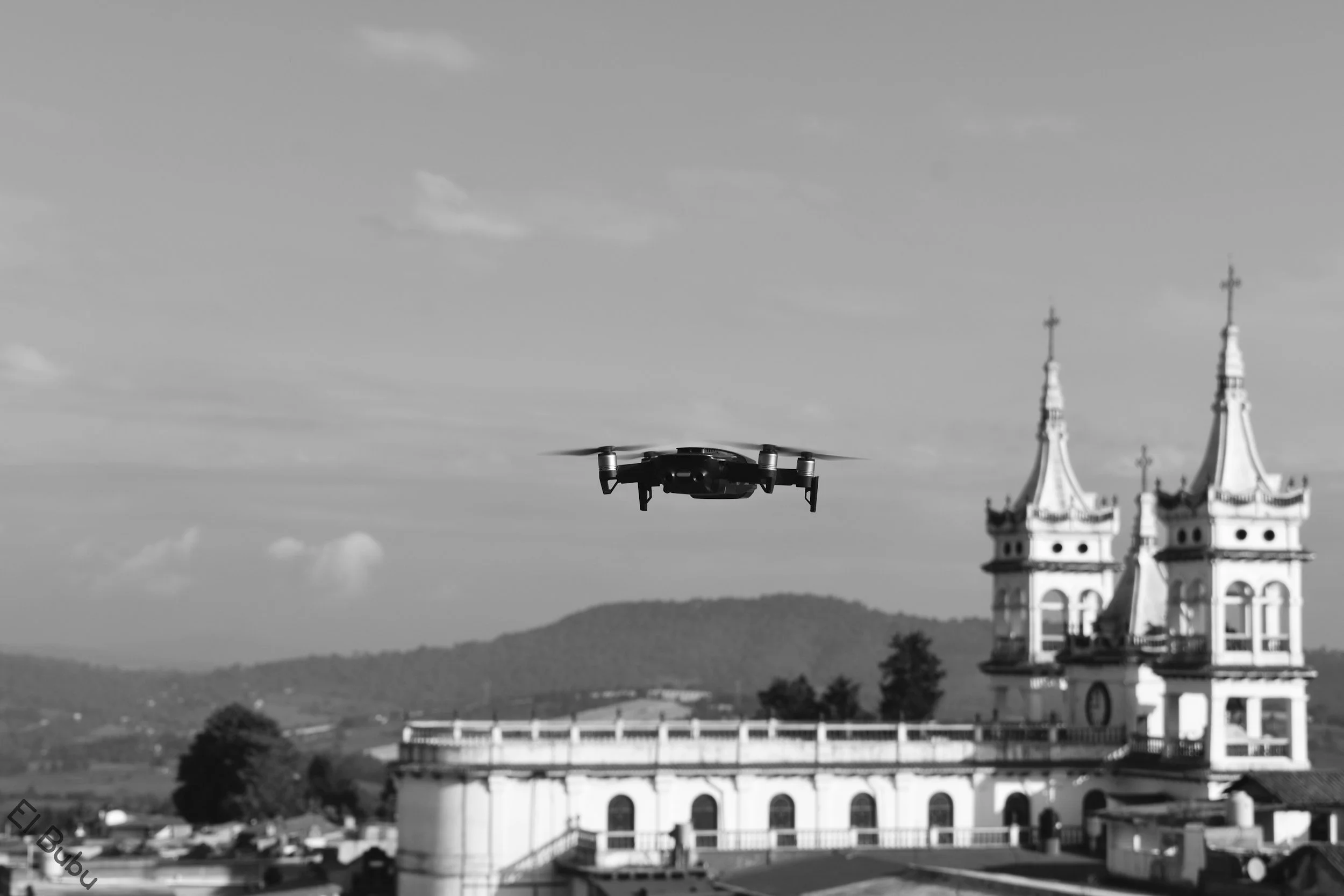
One night in Lo de Marcos, after hanging out the laundry, I sat behind the house at 10 Luis Echevarría. The children were asleep. The night was quiet. Then a drone descended — low, deliberate, close enough to suggest intention. It hovered long enough to register as a threat. Long enough to indicate that something was wrong.
It was not an isolated incident.
By the river.
At the beach.
In moments when I believed I was alone.
I got the impression after a long while, they really love drones. It’s like they have a new toy that gives them some sort of addition al control or power, proving into other people’s lives from high up there somewhere. Do they train with them? And why so many? There were quite a few drones in Lo de Marcos, but nothing compared to places like the Guadalajara bus terminal - I couldn’t believe how many there were, 100s of them, too many for such a small area. What do they do with all those drones? Do they have visuals on everyone through their phones, making sure the hack into everyone that comes in and out of terminals. My guess is that no one can get through the spyware that is being used in Mexico, unless you really have the technology to know how to block it. And I feel that certain organisations and even reporters know a lot more about what’s going on in Mexico regarding drones and spyware then what they let on.
A tourist accessing online banking in Mexico through their phone — that thought makes me uneasy now. Not because I know what anyone was doing, but because I lived through a period where it felt entirely possible that someone could be watching, wanting to know exactly how much money you had and how vulnerable you were. That feeling stays with you. All I know is that I will never use an Android phone in Mexico again. In fact, I don’t own one now. I’m still too nervous to. Even though I understand that whatever systems exist there do not reach into New Zealand in the same way, the experience changed how I see technology altogether. I don’t feel the need for anything complicated anymore. I just have a simple phone that cost me forty dollars, and that’s all I need.
Drones are now a global commodity — a multibillion‑dollar industry, a ubiquitous presence in both civilian and criminal contexts. A 2025 UN report described their proliferation as a “failure of humanity.” But that did not explain the timing, the proximity, or the repetition. Nor did it explain the contradiction visible everywhere around me: a country marked by deep poverty, where children sold trinkets on the beach to survive, yet saturated with technology that far exceeded the economic realities of the communities using it. The imbalance was impossible to ignore. It felt as though resources were being funnelled into tools of surveillance and control while the basic needs of ordinary people remained unmet.
So the inquiry deepened.
Who monitors a financially vulnerable mother of four.
Who interferes with someone already destabilised.
Who benefits from creating confusion or fear.
We were an ordinary Australian family. My ex‑husband was a retired military officer. We travelled quietly. The only public incident was an argument at the Mexico City airport — hardly the kind of event that would draw sustained attention.
Mexico has a long and well‑documented history with advanced surveillance tools, particularly the Israeli‑made Pegasus spyware. Over more than a decade, investigations by Citizen Lab, ARTICLE 19, R3D, SocialTIC, Amnesty International, The New York Times, and Aristegui Noticias have traced repeated misuse of Pegasus against individuals who posed no legitimate threat: journalists, lawyers, activists, public‑health advocates, and even the teenage son of a reporter.
In that context, it became clear how far outside the loop I was. Even reporters — the people most at risk — have their own networks of protection and collaboration. Projects like The Cartel Project and Forbidden Stories exist precisely because journalists have learned to defend one another when institutions fail. But those mechanisms are designed for reporters, not civilians. And that is the irony: journalists are not interested in investigating civilian cases either. The story is considered too small, too personal, too far outside the frameworks that justify institutional attention.
One category is consistently absent from every major surveillance report: tourists. Not because tourists are exempt, but because they are structurally invisible. They lack legal representation. They lack NGO support. They do not remain in the country long enough for forensic analysis. They do not know where to report anomalies. And even if they did, no institution is designed to investigate the claims of a foreign mother who leaves the country before any inquiry can begin. I understand that now.
In the world of investigative reporting, civilian cases occupy an uncomfortable space — too complex to dismiss, yet too diffuse to fit the structures journalists rely on to determine what is reportable, verifiable, or safe to pursue. The result is a quiet but consistent pattern: civilians fall outside the frameworks that guide journalistic attention.
Part of this is practical. Journalists are trained to follow stories that meet certain criteria: public interest, institutional accountability, corroboration, documentation, and a clear narrative arc. Civilian experiences, especially those involving cross‑border precarity or informal surveillance networks, rarely present themselves in such clean lines. They arrive fragmented, destabilised, and lacking the institutional anchors that make a story legible to an editor.
Another part is structural. High‑risk reporting environments like Mexico have forced journalists to develop their own protective ecosystems — collaborative investigations, encrypted communication channels, cross‑border partnerships like The Cartel Project and Forbidden Stories. These networks exist to safeguard reporters, not civilians. They are designed to protect people who already understand the rules of the profession, not those who stumble into danger without the language, contacts, or institutional backing to navigate it.
And then there is the question of scale. Civilian cases are often perceived as too small, too personal, too idiosyncratic to justify the risks involved in investigating them. A journalist weighing the dangers of reporting on organised‑crime dynamics will choose a story with systemic implications, not the experience of a single mother whose life unraveled in the shadows of those systems. The calculus is brutal but real: the risk must match the reach.
Tourists, in particular, fall into a category that journalism has no mechanism to address. They are transient, undocumented, and structurally invisible. They leave the country before any investigation can begin. They lack legal representation, NGO support, or the local networks that help reporters verify claims. Even when their experiences align with known patterns of surveillance overreach or criminal‑state overlap, the absence of institutional footprints makes their stories difficult to pursue.
The result is a blind spot — not because civilians are exempt from harm, but because the frameworks built to expose systemic wrongdoing were never designed to accommodate them. Civilian cases slip between the cracks of journalism just as they slip between the cracks of government systems. They occupy the grey zone where no one feels responsible, where no institution claims jurisdiction, and where the devastation of a life can unfold without ever becoming legible to the structures meant to protect it.
What I also did not understand was the broader surveillance environment I had entered. In Mexico, surveillance is not limited to state actors. Criminal organisations maintain their own systems — not military‑grade spyware, but networks built from human lookouts, corrupt officials, commercial tracking apps, radio scanners, and drones. These systems do not require sophistication; they require proximity, territory, and the ability to observe who enters and who does not belong.
Information circulates through informal channels: a taxi driver who notices a newcomer, a shopkeeper who reports unusual behaviour, a municipal employee who shares a detail without considering the implications. These systems are designed to monitor territory, not individuals, but visibility can be misinterpreted as significance. And I’ve seen how quickly information can move — people passing messages through their phones at extraordinary speed, monitoring and watching as if it were second nature.
A foreign woman alone with four children is visible in ways she cannot anticipate. Visibility is not the same as targeting, but in certain contexts it can feel indistinguishable from danger. There must have been a weakness they saw in me — something I didn’t realise I was signalling — because piece by piece, my life was stripped away. Everything I owned disappeared, whether through theft or because I had to sell it just to keep us alive. But when I lost my children, the ground shifted entirely. That was the moment the fear became something else. I wasn’t protected in Mexico, and I was terrified to return to Australia because of the domestic violence that had already shaped so much of my life. I was trapped between two worlds: one that had harmed me, and another that was now closing in around me.
In retrospect, my circumstances created a vulnerability profile that should have raised alarms: sudden abandonment, financial precarity, isolation in a foreign country, responsibility for four children, and proximity to regions shaped by organised‑crime dynamics. I had no support, no protection, and no framework for distinguishing coincidence from intent.
Public perception assumes that surveillance targets are “important” — journalists, activists, political figures. But the documented misuse of Pegasus contradicts that assumption. Surveillance overreach follows opportunity, not status. Vulnerability is its own form of exposure.
So when I ask whether my experience merits investigation, the question is not rooted in ego or paranoia. It is rooted in pattern. In precedent. In the documented reality that Mexico has repeatedly deployed tools far beyond their legal mandate, often against individuals who posed no threat at all.
I was not important.
But I was unprotected.
And that is often enough.
The absence of documentation does not indicate the absence of harm. It indicates the absence of oversight. No one expected a tourist — a mother with four children — to be a data point worth examining. But invisibility is not immunity. And what happened to me aligns too closely with known patterns to be dismissed simply because I do not resemble the individuals who typically appear in investigative reports.
This is why I write.
Not to assert certainty, but to document what occurred.
Not to demand belief, but to situate my experience within a broader, well‑established context of surveillance overreach and institutional blind spots.
If journalists and activists warrant investigation — and they do — then so does the woman who fell through the cracks. The one with no platform, no protection, and no way to interpret why her environment suddenly shifted into something she could no longer explain.
I was not the exception because I was unimportant.
I was the exception because no one was watching for people like me.
The irony is that the people who projected the greatest menace — the self‑styled “Masters of the Universe,” the supposed elite hackers, the so‑called controllers, ghosts, spies, spooks — were nothing close to what they imagined themselves to be. Their influence depended entirely on remaining unseen. They hid in the shadows not because they were powerful, but because exposure would have revealed how little they actually were.
With distance, the scale of their actions appears very different. The fear I lived inside magnified their presence, but once the immediacy of survival faded, the illusion of power collapsed. What remained was a more accurate assessment: not masterminds, not strategists, not shadowy operators, but small, frightened, and fundamentally incompetent individuals functioning inside a larger, dysfunctional system.
The mythology they projected — the posture of expertise, the suggestion of control, the performance of authority — does not withstand scrutiny. Their behaviour, once terrifying, now reads as insecurity posing as authority, incompetence dressed up as capability, chaos mistaken for strategy, fear disguised as control.
They were not orchestrating anything sophisticated. They were reacting. Scrambling. Covering their tracks. Performing for one another inside a structure that rewards bluster over intelligence. And I was the one who absorbed the consequences of their confusion.
The terror I felt was real. But the people behind it were not worthy of the fear they generated. They were never giants. They were shadows cast by a broken system — shadows that appeared enormous only because I was standing too close, too vulnerable, and too alone.
This realisation does not undo what happened, but it reframes it. It shifts the power back to where it belongs. It clarifies the truth:
I was not dealing with brilliance.
I was dealing with bluster.
Not with strategy, but with disorder.
Not with strength, but with cowardice.
And that shift — from fear to clarity — is the most significant discovery of all.
And once I understood that, everything shifted. I realised I had not been dealing with brilliance, but with bluster — not with strategy, but with disorder. Not with strength, but with cowardice. And that shift, from fear to clarity, is what finally allowed me to name them.
Who are the pineapples?
“Pineapples” is the name I gave to the people who looked powerful only when I was afraid. They were not masterminds or strategists, but a loose constellation of individuals acting with bluster, insecurity, and disorder — people whose behaviour created the illusion of coordination without the substance to support it. The term became a way to describe the gap between appearance and reality: the inflated shadow cast by small actors inside broken systems. It is not a group, not an organisation, not a network. It is a category of conduct — intimidation without intelligence, performance without capability, noise without structure. “Pineapples” is simply the most accurate word I have for the people who seemed enormous up close and insignificant once I stepped back and saw the truth.