When a man points a loaded gun at your head, how does that change you?
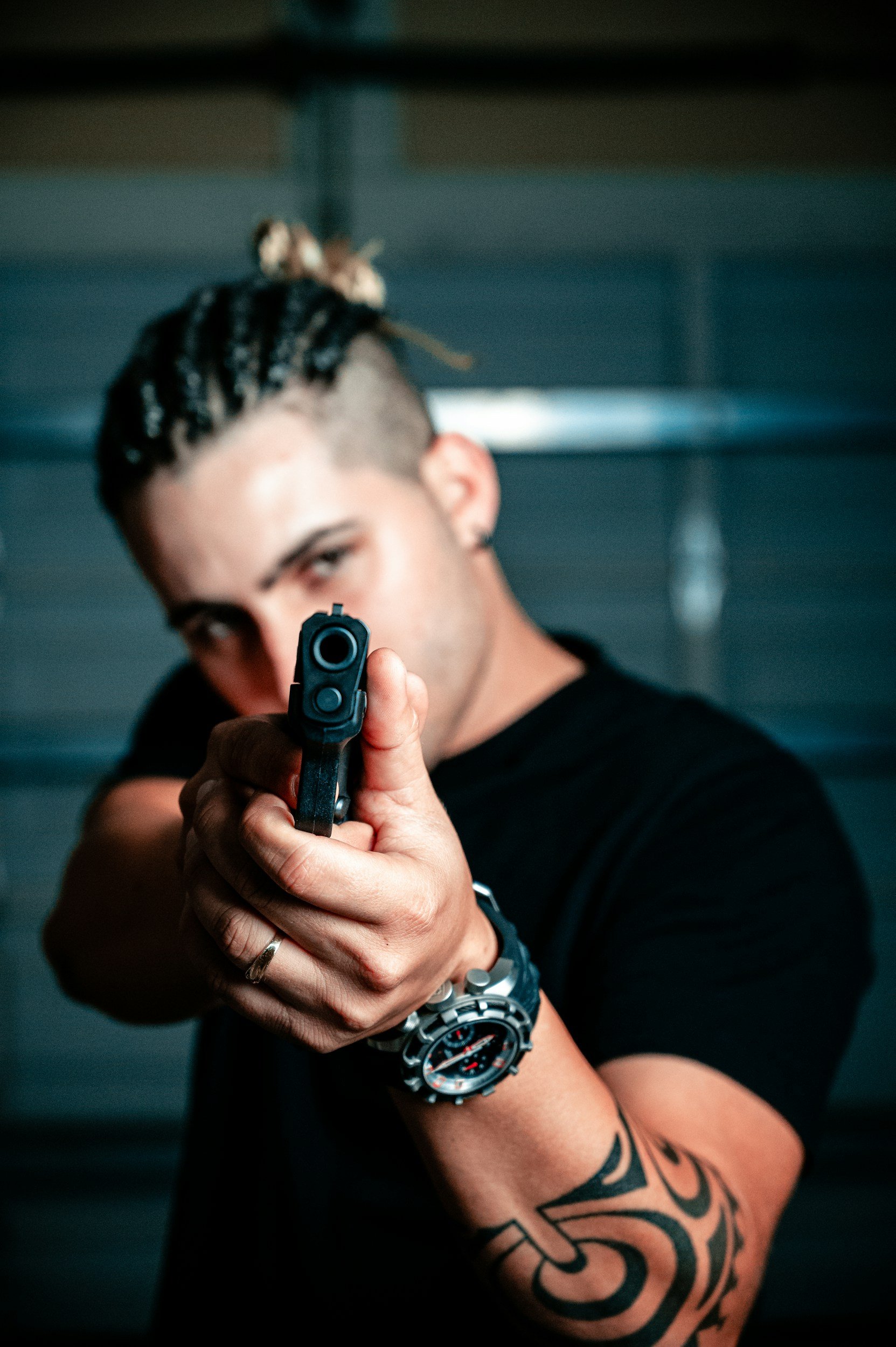
When a man points a loaded gun at your head, how does that change you?
I Lost My Children — Whose Fault Is It
Maybe it is my fault because my ex‑husband put a gun to my head.
When a man points a loaded gun at your head, something fundamental in you rearranges itself. The world doesn’t end, but it tilts — permanently — and you tilt with it. Your nervous system learns a new language in an instant: metal shifting, breath tightening, the calculation of distance and escape.
But when the man holding the gun is your husband, the shift is deeper. It is not just fear. It is the collapse of the last place you believed you were meant to be safe. It is the moment the person who vowed to protect your life becomes the person who threatens it.
There is no returning to who you were before that.
The Moment That Rewrote Everything
The body records a gun to the head as fact. Not drama. Not exaggeration. A near‑death event.
I remember the angle of his arm.
The shift in his breathing.
The way the room contracted around us.
Terror is not loud. It is hollowing. It suspends you between instinct and disbelief. There were no words. No screams. Only a silence so sharp it felt like another weapon.
Then something broke loose — a survival impulse older than language. I ran. I grabbed our children and ran. People imagine courage as decisive and heroic. Mine was shaking hands and a pounding heart.
But I got them out.
The Values He Was Trained Under — And The Ones He Violated
He was a retired Australian Army officer. A man shaped, at least publicly, by two layers of institutional values:
ADF values: Service, Courage, Respect, Integrity, Excellence, Loyalty.
Army CIRT values: Courage, Initiative, Respect, Teamwork.
None of those values were present in the room that day.
Service — yet he endangered the people he was meant to protect.
Courage — yet he used fear as leverage.
Respect — yet he stripped me of dignity.
Integrity — yet he lived two lives.
Loyalty — yet he turned on his own family.
The uniform concealed a private reality no one wanted to examine.
The Trap That Kept Me Silent
There was also the financial control.
Every dollar tied to him.
Every decision tied to him.
Every exit route tied to him.
A system engineered to keep me compliant, dependent, silent.
That is why I didn’t report him. Not because I doubted myself. Not because I was weak. But because I understood exactly what he was capable of. Reporting him could have escalated the danger. It could have cost me my children. It could have cost me my life.
We were living in Nayarit, Mexico. Reporting him locally felt dangerous — not for me, but for him. Trauma distorts logic. It convinces you that protecting the person who harms you is safer than exposing him.
I documented everything with a lawyer. A full report. But I didn’t file it. I believed Australia would intervene.
It never did.
The Second Injury: Institutional Silence
Institutional silence doesn’t arrive all at once. It accumulates.
A hesitation.
A distance.
A procedural indifference.
For someone living inside the aftermath of coercive control, that silence is not neutral. It is another form of harm.
I had survived a near‑death event at the hands of a man trained by the Australian Defence Force. I believed the institution would recognise the breach. That it would intervene. That it would uphold its own standards.
It didn’t.
No inquiry.
No follow‑up.
No accountability.
The message was clear: what happened to me — and to our children — did not meet the threshold for concern.
The Aftermath That Never Ended
Coercive control does not end when the relationship ends.
It continues in the systems that fail to recognise it.
It continues in the aftermath, when the victim is left to navigate the consequences alone.
It continues in the long‑term effects that settle into the body like sediment.
I learned to sleep without scanning the room.
To breathe without anticipating danger.
To make decisions without fear of retaliation.
But the deeper changes were harder to name.
My nervous system had been rewired.
My sense of safety rewritten.
I learned to read danger with forensic precision because danger had once lived in my home.
And layered over everything was a quieter truth:
I felt lost.
Confused.
Abandoned by the governments that were supposed to protect me.
Victimised not only by him, but by the institutions that looked away.
No support.
No understanding.
No acknowledgement.
No apology.
The silence became its own kind of violence.
The Question That Remains
People who have never lived under coercive control ask, Why didn’t you leave.
People who understand trauma ask, How did you survive.
But the more accurate question — the one institutions avoid — is:
What conditions allowed this to continue.
Survival is not the end of the story.
It is the beginning of the reckoning.
And now, even after everything, I find myself standing in the same silence.
Waiting for accountability that never comes.
For recognition that never arrives.
For a system that still refuses to see what happened.
There is no closure.
No resolution.
No apology.
Just the ongoing weight of what was done, and what was ignored.
I lost my children. Whose fault is it.